Vintage Computer Collection
Overview of selected systems and artefacts from Achim Baqué’s large vintage computer collection, from early electronic calculators, microcomputers, minicomputers to storage history, Apple-1 research, Cray supercomputers and historically important documentation.
Presenting it in its entirety would be a monumental task. For selected systems, I have published information here, along with a number of photographs. These entries offer a glimpse into the collection and into the stories behind some of its historically significant machines.
My favorite items
- Librascope 48" and Bryant 39" hard disks (196x)
- IBM 360/75 console (196x)
- Kenbak-1 prototype (1971)
- Micral S (1974)
- RGS-008A (1974)
- JOLT (1975)
- My Apple-1 Computer collection (1976)
- Cray-1S Supercomputer (1979)
- Lilith (1980)
Content (a few selected items from my collection)
- Historic Hard Disks (1950s–1980s)
- IBM 360 Mainframe Consoles (196x)
- ANITA Mk VIII (1961)
- DEC PDP-8 “Straight-8” (1965)
- Olivetti Programma 101 (1965) and Programma 203 (1967)
- HP-9100A (1968)
- GRI 909 (1969)
- Datapoint 2200 (1970)
- WANG 600, 700 and 720 (1970s)
- HP-9810A (1971), 9830A (1972), 9825A (1976), 9845A (1977), 9835A (1979) etc.
- ICL 1501 / Cogar System 4 (1971)
- Kenbak-1 prototype and Kenbak-1 Registry (1971)
- NRI-832 (1971)
- Texas Instruments Microprogrammer LCM-100 (1971)
- Intel SIM8-01 (1972)
- Q1 (1972)
- Intel Intellec 4 (1973) and Intellec 8 (1974)
- WANG 2200 Systems (1973 onward)
- Altair 8800 (1974), 8800b (1976), 8800 Turnkey (1977)
- Mark-8 (1974)
- Micral S (1974)
- RGS-008A (1974)
- IBM 5100 (1975)
- IMSAI 8080 (1975)
- IMSAI PCS 80 (1975)
- ITT Digital Trainer (1975)
- JOLT (1975)
- Olivetti P6040 (1975)
- Olivetti P6060 (1975)
- Other S-100 systems (1975–1979)
- SWTPC 6800 (1975), 6809 (1979) and PR-40 printer
- VIM-1 / SYM-1 (1975)
- AIM-65 (1976)
- Apple-1 Computers (1976)
- Apple-1 Registry (1976)
- Apple-1 Research (1976)
- Baby! 1 by STM Systems (1976)
- Cosmac ELF (1976)
- Cosmac Microtutor (1976)
- IASIS IA-7301 (1976)
- Intel MCS-85 (1976)
- Intel Prompt 48 (1976)
- KIM-1 (1976)
- Micro-68 (1976)
- Motorola MEK6800D2 Microcomputer (1976)
- SOL-20 (1976)
- Texas Instruments Microprogrammer LCM-1001 (1976)
- Apple Disk Drive S/N 2 (1977/1978)
- Apple II Rev. 0 (1977)
- Byt-8 (1977)
- Christiani SC/MP (1977)
- Compucolor II (1977)
- IMSAI 8048 (1977)
- Intel MCS-85 / SDK-85 (1977)
- Nascom 1 (1977) and Nascom 2 (1979)
- Polymorphic S-100 (1977)
- RCA Super ELF (1977)
- Science of Cambridge MK-14 (1977)
- SuperJOLT (1977)
- Vector-1 (1977)
- Cromemco System Three (1978)
- DPS-1 (1978)
- Dynabyte DB 8/2 (1978)
- E & L Instruments Mini Micro Designer MMD-1 (1978)
- One-millionth 8-inch Floppy Drive (late 1970s)
- Ontel OP-1 (late 1970s)
- OS Model 600 (1978)
- Sharp MZ-40K (1978)
- Signetics Instructor 50 (1978)
- Compukit UK-101 (1979)
- Cray-1S Supercomputer (1979)
- Intel SBC 86/12A (1979)
- Intel SDK-86 (1979)
- ITT MP Experimenter 8080 (1979)
- Kienzle 1140-20 Taximeter (1979)
- MI-650C PROMAX (1979)
- Northstar Horizon (1979)
- Open University PT501 (1979)
- Polymorphic 8813 (1979)
- IBM 5120 (1980)
- Lilith (1980)
- 1-Bit Computer (1981)
- Apple Lisa-1 (1983)
- Commodore C65 (1991)
Detailed Entries
These entries link to dedicated information about particularly important systems and artefacts from my collection.
Historic Hard Disks (1950s–1980s)
My hard disk collection covers large and historically important storage systems, platters and related artefacts from several generations of computing.
IBM 360 Mainframe Consoles (196x)
My IBM System/360 console collection includes several iconic front panels from one of the most influential mainframe families ever built.
ANITA Mk VIII (1961)
The ANITA Mk VIII marks the transition from mechanical office calculators to all-electronic desktop calculation.
DEC PDP-8 “Straight-8” (1965)
The original PDP-8, often called the Straight-8, is a landmark minicomputer and one of the most important machines in the move toward smaller, more affordable computing.
Olivetti Programma 101 (1965) and Programma 203 (1967)
The Programma 101 and Programma 203 are important milestones in the history of programmable desktop computing.
HP-9100A (1968)
The HP-9100A brought powerful programmable scientific calculation to the desktop and is one of the most important machines of its class.
Datapoint 2200 (1970)
The Datapoint 2200 is historically important because its architecture influenced the development path that led to the Intel 8008 and later x86-compatible processors.
WANG 600, 700 and 720 (1970s)
The WANG 600, 700 and 720 systems represent an important generation of programmable desktop calculators before the widespread adoption of personal computers.
Kenbak-1 and Kenbak-1 Registry (1971)
My Kenbak-1 material includes the unique prototype and work to preserve John Blankenbaker’s legacy.
Q1 (1972)
The Q1 is an early and historically significant microcomputer-class system from the early 1970s.
WANG 2200 Systems (1973 onward)
The WANG 2200 systems brought BASIC-oriented interactive computing into a professional desktop environment.
Mark-8 (1974)
My Mark-8 came directly from its first owner, who assembled and preserved the computer for decades.
Micral S (1974)
The Micral S belongs to the rare early French Micral line, one of the most important European branches of early microcomputer history.
RGS-008A (1974)
The RGS-008A is among the rarest early microcomputers in my collection and is supported by historical documents and interviews.
JOLT (1975)
My JOLT is an extremely rare early 6502-based computer associated with Ray Holt and Microcomputer Associates.
Apple-1 Registry (1976)
The Apple-1 Registry documents all known surviving Apple-1 computers and related historical information.
Apple-1 Research (1976)
My Apple-1 research focuses on provenance, serial-number evidence, first-hand accounts and the preservation of early Apple history.
Baby! 1 by STM Systems (1976)
The Baby! 1 is an early 6502-based transportable microcomputer from STM Systems.
My Apple-1 Computers (1976)
My Apple-1 collection contains historically important original Apple-1 computers, including examples with exceptional provenance.
Apple Disk Drive S/N 2 (1977/1978)
Apple Disk Drive S/N 2 came from Dr Wendell Sander and is connected to a crucial correction in the early Disk II controller PROMs.
Apple II Rev. 0 (1977)
My early Apple II Revision 0 systems include very low serial-number examples and ventless units, representing Apple’s decisive step from the Apple-1 board computer to a mass-market personal computer.
Byt-8 (1977)
The Byt-8 is a rare 8080-based microcomputer from the formative period of personal computing.
Compucolor II (1977)
The Compucolor II is an early colour personal computer with an integrated display and floppy-based storage.
One-millionth 8-inch Floppy Drive (late 1970s)
The one-millionth Shugart 8-inch floppy disk drive presented to WANG Laboratories is a remarkable storage-history artefact.
Ontel OP-1 (late 1970s)
My Ontel OP-1 is an extremely rare early office computer that illustrates the transition from minicomputers to smaller business systems.
Cray-1S Supercomputer (1979)
My Cray material includes the Cray-1S s/n 53 and related research into the provenance and preservation of these iconic supercomputers.
Lilith (1980)
My Lilith is a first-generation workstation in a walnut case, closely connected with the ETH Zurich computing environment around Niklaus Wirth.
1-Bit Computer (1981)
This rare German 1-bit educational computer is based on a minimal architecture designed to teach fundamental logic and control concepts.
Apple Lisa-1 (1983)
My Apple Lisa-1 material documents one of Apple’s most ambitious early graphical workstation projects and an important milestone in the history of user interfaces.
Collection Items
GRI 909 (1969)
An Early System for Embedded and Process Control
The GRI-909, introduced in 1969 by the newly founded GRI Computer Corporation, was among the earliest microcomputer systems developed specifically for industrial and embedded computing tasks. It was designed to handle real-time data processing, control operations, and instrumentation management in environments where reliability and simplicity were essential.
Purpose and Design
Built for efficiency and dependability, the GRI-909 featured a straightforward, single-instruction format that allowed engineers and technicians to create stable systems for process control and automation. It supported memory configurations ranging from 4K to 32K words, depending on the needs of the application.
Input and output options included teletype terminals, paper tape readers and punches, and clock modules, components well-suited for industrial use. The system was intentionally modular, offering customization based on specific tasks and environments.
Evolution and Legacy
Following the GRI-909, the company released enhanced models such as the GRI-99, which introduced new features including index registers to expand the programming capabilities. A further model, the GRI-919, was also developed, although fewer details about it are available today.
The GRI-909 belongs to the era of third-generation computers, characterized by the use of integrated circuits rather than discrete transistors. While not a mainstream commercial computer, the GRI-909 played a crucial role in bridging the gap between traditional minicomputers and the later emergence of microcontrollers and embedded systems.
Significance
The significance of the GRI-909 lies in its application rather than its popularity. It served in industrial settings where precision and dependability were essential, long before personal computing entered the scene. As one of the early examples of dedicated embedded computing, it illustrates how specialized computing began to take shape in the late 1960s.
Today, the GRI-909 is a rare and valuable example of the innovation that powered early automation and real-time control systems. It stands as a quiet yet important milestone in the evolution of computing technology.
HP-9810A (1971), 9830A (1972), 9825A (1976), 9845A (1977), 9835A (1979) etc.
I own many early Hewlett-Packard Programmable Calculators and Computers of the 1970s.
Hewlett-Packard was a key innovator in programmable calculators and early computing systems throughout the 1970s. Their models combined powerful computing capabilities with ease of use, targeting engineers, scientists, and business professionals. The following machines represent important milestones in this progression:
HP-9810A (1971)
The HP-9810A was introduced as one of the first programmable calculators with a built-in alphanumeric keyboard and an integrated display. It allowed users to write and execute programs in a version of BASIC designed by Hewlett-Packard. This machine made programmable computing accessible to professionals who required calculation automation without a full computer system.
HP-9830A (1972)
Following the success of the 9810A, the HP-9830A was a more advanced programmable desktop computer. It featured expanded memory and improved display capabilities. It included support for external peripherals such as printers and disk drives, making it a versatile tool for engineering and scientific computations.
HP-9845A (1977)
The HP-9845A was designed as a powerful desktop workstation, equipped with a high-resolution display and advanced graphics capabilities. It supported a full programming environment, including the HP BASIC language, and featured integrated peripherals such as tape drives and printers. This system was widely used for data analysis, simulation, and complex calculations.
HP-9825A (1976)
The HP-9825A was a notable model in the HP series, providing enhanced processing power and storage compared to earlier machines. It was known for its fast execution speed and was often used in laboratory automation and industrial control environments. The 9825A had a built-in floppy disk drive and a display capable of showing multiple lines of text.
HP-9835A (1979)
The HP-9835A marked the transition to more powerful desktop computing systems with improved memory, faster processors, and better input/output capabilities. It supported advanced programming features and expanded connectivity to external devices, making it suitable for complex scientific and business applications.
Together, these Hewlett-Packard models illustrate the rapid evolution of programmable calculators and early desktop computers during the 1970s. They helped pave the way for personal computing by combining user-friendly design with powerful capabilities. Today, these machines are celebrated for their role in bringing computing power to the desktop and are preserved in many technology museums worldwide.
ICL 1501 / Cogar System 4 (1971)
The ICL 1501 has its origins in the Cogar System 4, an early intelligent terminal developed in the United States in 1971 by George R. Cogar and his company, Cogar Corporation. The System 4 was designed as a compact, self-contained computer that combined processing power, memory, display, keyboard, and data storage in one desktop unit.
The Cogar System 4 featured advanced technology for its time, including a high-resolution CRT screen and a magnetic tape storage system. It was intended to serve as an intelligent terminal capable of handling complex data entry and processing tasks with ease.
In 1976, Singer Business Machines acquired Cogar Corporation and rebranded the System 4 as the Singer 1500. Shortly after, International Computers Limited (ICL), a British computing company, purchased Singer Business Machines. ICL continued development of the machine, renaming it the ICL 1501.
The ICL 1501 maintained the core architecture and design principles of the Cogar System 4, while ICL adapted the system for broader markets and integrated it into their product lineup. This computer system represented a transition from early intelligent terminals toward more versatile business computers capable of meeting various commercial and governmental needs.
The evolution of the ICL 1501 from the Cogar System 4 highlights an important example of international collaboration and technological transfer during the early years of computing. It remains a notable artifact in computer history, illustrating how innovative designs can cross borders and evolve through corporate changes to influence computing on a larger scale.
NRI-832 (1971)
A Versatile Microprocessor Development System
The NRI-832 is an early microprocessor development system created by National Radio Institute in the 1970s. Designed to support a variety of microprocessors, the NRI-832 provided engineers, students, and hobbyists with a practical platform for learning, programming, and testing microprocessor applications.
Equipped with a keyboard, display, memory, and input/output ports, the NRI-832 allowed users to write and debug programs in assembly language and machine code. Its flexible design made it compatible with several popular microprocessors of the time, making it a valuable educational and development tool.
Used widely in technical schools and training programs, the NRI-832 helped many people gain hands-on experience with microprocessor technology. It also found use in research labs and small businesses developing custom control systems and embedded applications.
Today, the NRI-832 stands as an important example of early microcomputer education and development systems. Museums and collectors value it for illustrating how microprocessor technology was introduced and taught during the formative years of the personal computing revolution.
Texas Instruments Microprogrammer LCM-100 (1971)
The Texas Instruments LCM-100 Microprogrammer, introduced in the early 1970s, represents a significant yet often overlooked milestone in the evolution of computing. Unlike general-purpose computers of its time, the LCM-100 was a development tool specifically designed for creating and testing microprogrammed control logic. It was aimed at engineers, researchers, and computer designers who were exploring the frontiers of programmable systems and processor architecture.
Microprogramming is a method used to control the internal operations of a processor. Instead of relying on fixed, hardwired control logic, microprogramming allows the behavior of a processor to be defined through sequences of microinstructions. These microinstructions are stored in a special control memory and can be altered to modify the machine’s functionality without changing its physical hardware. This concept introduced a new level of flexibility in system design, enabling faster innovation and experimentation.
The LCM-100 provided a dedicated environment for working with microinstructions. It featured an integrated keyboard and display, allowing users to write, edit, and review microcode directly. The system included memory for storing control logic, as well as interfaces for simulating processor behavior and connecting to external hardware. Through these features, engineers could prototype new instruction sets, simulate the execution of complex operations, and refine their designs without needing to rebuild circuitry for every modification.
Although the LCM-100 was not produced in large numbers, it found use in research institutions, laboratories, and advanced engineering settings. It was part of a broader shift in the computing world, a transition from rigid, hardware-bound designs to more dynamic, software-controlled systems. Tools like the LCM-100 empowered developers to think differently about how computers could be built and operated.
Today, the LCM-100 is considered a rare artifact of computing history. Few examples remain, and those that do are typically held in museums or private collections. Its importance lies not in widespread commercial adoption, but in the role it played in shaping the way we design and understand computers. As a tool for experimentation and education, it helped lay the foundation for the programmable architectures that define modern computing.
In the context of early 1970s technology, the LCM-100 stands as a symbol of innovation and vision. It reflects a moment when engineers began to realize that the future of computing would be driven not just by hardware, but by the power to program, modify, and adapt systems to meet new challenges. As such, it holds a valuable place in the timeline of technological progress.
Intel SIM8-01 (1972)
One of the few computers using the Intel 8008.
An Early Development Kit for the Intel 8008 Microprocessor
The SIM8-01 is one of the earliest microprocessor development kits designed for the Intel 8008, Intel’s first 8-bit microprocessor released in 1972. Created to help engineers and hobbyists explore the capabilities of this pioneering chip, the SIM8-01 provided a hands-on platform for programming and hardware experimentation.
The SIM8-01 featured a simple circuit board with the Intel 8008 CPU, memory, input/output ports, and a front panel with switches and lights. Users could enter machine code directly via the switches and observe the processor’s operations through the lights. This made the SIM8-01 a powerful educational tool for understanding how microprocessors execute instructions at a fundamental level.
Though basic by modern standards, the SIM8-01 was invaluable at a time when microprocessors were brand new and development tools were scarce. It allowed early computer engineers to test programs, develop custom hardware interfaces, and learn the inner workings of the 8008 chip.
The kit helped pave the way for more advanced microprocessor systems and inspired a generation of engineers who would go on to create the first personal computers.
Today, the SIM8-01 is a rare and important artifact in computer history. Museums and collectors prize it for its role in the dawn of the microprocessor era and as a reminder of the pioneering spirit that drove early computing innovation.
Intel Intellec 4 (1973) and Intellec 8 (1974)
The First Development Systems for Early Microprocessors
The Intel Intellec 4 and Intellec 8 were groundbreaking development systems created by Intel in the early 1970s to support their new line of microprocessors. These machines were not personal computers as we think of them today but were essential tools for engineers and developers working on the first wave of microprocessor-based products.
The Intellec 4 was introduced in 1973 as one of the first systems designed to work with the Intel 4004, the world’s first commercial microprocessor. It allowed engineers to test, debug, and write programs for products that would use the 4004, such as calculators, terminals, and other embedded devices. The Intellec 4 provided a reliable way to work with this new chip at a time when tools for microprocessor development were almost non-existent.
Following the success of the Intellec 4, Intel released the Intellec 8 in 1974 to support its next generation of microprocessors, starting with the Intel 8008 and later the very popular Intel 8080. The Intellec 8 made it much easier for engineers to develop and test early computers, industrial controllers, and custom electronics that used these more powerful chips.
Both systems came with built-in memory, input and output ports, and a front panel interface for controlling and monitoring programs. They could be connected to terminals, printers, and other devices, providing a complete lab setup for microprocessor development.
The Intellec 4 and Intellec 8 played a huge role in launching the microcomputer revolution. Many companies that built the first hobby and personal computers used these systems to create and test their designs before moving to production.
Today, the Intellec systems are valuable museum pieces that show how engineers first worked with microprocessors. They stand as important reminders of how this technology moved from tiny lab setups to the powerful computers we use every day.
Altair 8800 (1974), 8800b (1976), 8800 Turnkey (1977)
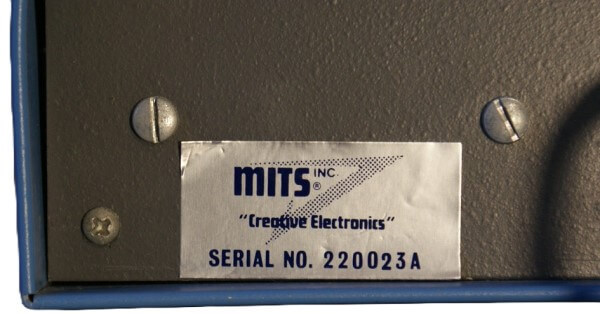 +
Altair 8800 S/N 23
+
Altair 8800 S/N 23
There are many Altairs in my collection, including the Altair 8800 S/N 23.
The Beginning of the Personal Computer Revolution
The Altair series holds a special place in computer history as the spark that started the personal computer revolution. Created by MITS (Micro Instrumentation and Telemetry Systems) and introduced in 1975, the Altair 8800 is often called the first commercially successful personal computer.
The original Altair 8800 used the Intel 8080 microprocessor and was sold as a kit that hobbyists could assemble at home. It had a simple front panel with switches and blinking lights, which users used to enter programs and see output. Though very basic, the Altair 8800 inspired thousands of early computer enthusiasts to learn about programming and hardware. It also led to the creation of early computer clubs, where people shared ideas and software.
Following the success of the 8800, MITS introduced the Altair 8800b, which offered improvements such as a stronger power supply, a better backplane for expansion cards, and a redesigned case. The 8800b made it easier for users to expand their systems and run more complex software.
The Altair 860 was a less common member of the Altair family. It was designed as a smaller and more affordable option for people who needed basic computing power but did not want to build an entire system from scratch.
To meet the needs of business users who wanted a complete and ready-to-use system, MITS also released the Altair Turnkey System. This version came with a cabinet, a built-in disk drive, and a prewired configuration that allowed users to operate the computer without having to work with the front panel switches. It was an important step toward making personal computers more practical for offices and small businesses.
Together, the Altair computers created a new industry. They inspired young programmers, including Bill Gates and Paul Allen, who developed the first version of Microsoft BASIC for the Altair. The Altair series showed that a computer could fit on a desk and be owned by individuals, paving the way for the modern personal computer.
Today, the Altair 8800 and its later models are celebrated as the machines that helped launch the age of home computing. In museums, the Altair reminds us of the curiosity, creativity, and community spirit that shaped the early days of personal technology.
IBM 5100 (1975)
 +
One of my IBM 5100
+
One of my IBM 5100
One of the First Portable Computers
The IBM 5100, introduced in 1975, is widely recognised as one of the first portable computers. At a time when most computers were large systems kept in data centers or laboratories, the IBM 5100 brought serious computing power to a machine that could fit on a desk and even be carried by one person.
Weighing about fifty pounds, the IBM 5100 included a built-in five-inch CRT display, a keyboard, and a built-in tape drive for data storage and program loading. Users could run programs written in BASIC or APL, two popular programming languages of the time. This made the IBM 5100 very flexible for engineers, scientists, and professionals who needed computing power outside the mainframe environment.
One of the 5100’s biggest innovations was its use of an emulator to run mainframe software on a small portable system. This feature let users work on the same code they would use on larger IBM machines, saving time and money. The 5100 did not require any special installation or supporting equipment, which was a major advantage over larger systems.
Although the IBM 5100 was expensive and sold mainly to companies and research institutions, it showed what a small computer could do when designed for practical work. It helped pave the way for later portable and personal computers, including IBM’s own more famous IBM PC that arrived in 1981.
Today, the IBM 5100 is an important part of computing history and a favourite among collectors and museums. It marks an early moment when the idea of portable computing moved from science fiction to real life, setting the stage for the laptops and mobile devices we rely on today.
IMSAI 8080 (1975)
A Pioneer in Early Personal Computing
The IMSAI 8080 is one of the most famous early personal computers and a key player in the history of home computing. Released in 1975 by IMS Associates, Inc., the IMSAI 8080 was based on the Intel 8080 microprocessor and was compatible with the S-100 bus standard.
The IMSAI 8080 quickly gained popularity among hobbyists and early computer users because it offered a complete system with a front panel, switches, and lights for input and output. It was sold both as a kit and as a pre-assembled unit, making it accessible to a wide range of users.
One of the IMSAI 801980s strengths was its expandability. Users could add memory, storage devices, and peripheral cards to customize their systems. This flexibility made the IMSAI 8080 suitable for both personal experimentation and professional use in small businesses.
The IMSAI 8080 played an important role in inspiring early computer clubs and communities. It was also the platform for early software development and programming experiments. Its design influenced later personal computers and helped set the standard for what users expected in terms of expandability and usability.
Today, the IMSAI 8080 is celebrated by collectors and computing historians as a symbol of the early personal computer movement. Museums use it to illustrate how computing moved from large institutions into the hands of individuals and small businesses, laying the foundation for the digital world we live in today.
IMSAI PCS 80 (1975)
Bringing S-100 Computing to Small Businesses and Hobbyists
The IMSAI PCS 80 is an important but often overlooked member of IMSAI’s family of early personal computers. Introduced after the iconic IMSAI 8080, the PCS 80 continued the company’s mission to make powerful microcomputers available to small businesses, schools, and advanced hobbyists.
The PCS 80 was based on the popular S-100 bus architecture, which allowed users to customize and expand their systems with a variety of compatible cards. Like the 8080, the PCS 80 used reliable microprocessors such as the Intel 8080 or Zilog Z80. This made it capable of running popular operating systems like CP/M and a growing library of business and development software.
What set the PCS 80 apart was its improved design for practical daily use. It featured a more refined cabinet and came with options for built-in floppy disk drives, making it a more complete and ready-to-use system. While earlier IMSAI machines were mostly assembled by dedicated hobbyists, the PCS 80 appealed to professionals and small companies who needed an affordable and flexible desktop computer that could handle word processing, accounting, and custom applications.
With its balance of expandability, performance, and ease of use, the IMSAI PCS 80 showed how S-100 computers could move from hobbyist workshops into small offices and classrooms. It also helped maintain IMSAI’s place as one of the best-known names during the early days of personal computing.
Today, the IMSAI PCS 80 is an interesting piece for collectors and museums. It reminds visitors how quickly microcomputers evolved from blinking lights and toggle switches to more practical and business-ready machines that helped shape the modern computing world.
ITT Digital Trainer (1975)
The ITT Digital Trainer was an educational and experimental computing device developed to teach and demonstrate the fundamentals of digital logic, microprocessor operation, and basic computer architecture. It was typically used in academic settings, technical schools, and by electronics hobbyists during the late 1970s.
The ITT Digital Trainer was not a full-featured computer, but rather a training system designed to help students understand how digital circuits and microprocessors work. It included a breadboard area, LED indicators, toggle switches, pushbuttons, and in some models, a hexadecimal keypad or seven-segment displays. These features allowed users to construct logic circuits manually, program simple routines, and observe their behavior in real time.
Some versions were designed to interface with early microprocessors, such as the Intel 8080 or Zilog Z80, providing learners hands-on experience with actual processor instruction sets and machine-level programming.
The ITT Digital Trainer was part of a broader movement in the 1970s and 1980s to bring hands-on electronics and computing education into classrooms. Before high-level programming languages and personal computers became widespread, understanding computers often meant learning at the hardware level. The trainer helped build foundational skills in logic gates, binary arithmetic, register-level processing, and basic input-output systems.
Today, the ITT Digital Trainer is remembered as a valuable educational tool that helped many early computer engineers and technicians begin their careers. Although technology has advanced far beyond such systems, their legacy lives on in modern educational kits like Arduino and FPGA development boards that continue to emphasize hands-on learning.
The ITT Digital Trainer is now a collector's item and a historical reminder of the transition from analog electronics to digital computing.
Olivetti P6040 (1975)
The Olivetti P6040 was introduced in 1975 by the Italian company Olivetti. It is recognised as one of the early microprocessor-based personal computers, marking an important step in the transition from calculators and typewriters to programmable computing devices.
The P6040 utilized the Intel 4004 microprocessor, the first commercially available microprocessor, which gave the machine remarkable processing power for its time. It featured a compact design with a small display and a keyboard, making it suitable for office and technical applications.
Programmable and versatile, the P6040 was capable of handling various business and engineering tasks. Its innovative use of microprocessor technology distinguished it from earlier machines and set the stage for future developments in personal computing.
Though not widely produced, the Olivetti P6040 remains a significant artifact in computer history. It reflects Olivetti’s forward-thinking approach to design and technology during the mid-1970s and highlights Italy’s role in early computer innovation.
Today, the P6040 is preserved in museums and collections as a symbol of early microprocessor adoption and the evolution of personal computers.
Olivetti P6060 (1975)
The Olivetti P6060 is a pioneering personal computer introduced in 1975 by the Italian company Olivetti. Known for its innovative design and integration of advanced technology, the P6060 represents one of the earliest attempts to create a complete computing system for office and business use.
The P6060 was built around the Intel 8080 microprocessor, which operated at a clock speed of 2 megahertz. It featured a built-in 32-character display and an integrated floppy disk drive, making it one of the first computers to include floppy disk storage as a standard feature. The computer also had a built-in printer, allowing users to produce hard copies without needing external devices.
One of the P6060’s key features was its programming language support, which included BASIC and other languages suitable for business applications. The system was designed to be user-friendly and compact, targeting professionals who needed computing power directly on their desks.
Though produced in limited quantities, the Olivetti P6060 was well regarded for its reliability and forward-thinking design. It marked an important step for Olivetti in the transition from typewriters and calculators to full computing systems.
Today, the Olivetti P6060 is preserved in computing museums as a symbol of early innovation in the personal computer industry and Italy’s contribution to computer technology development.
Other S-100 systems (1975–1979)
SWTPC 6800 (1975), 6809 (1979) and PR-40 printer
I own several SWTPC 6800 systems, the rare SWTPC 6809 and the SWTPC PR-40 printer.
A Pioneer of Affordable Home Computers and Kits
SWTPC, short for Southwest Technical Products Corporation, was an influential company that helped bring computing to hobbyists and small businesses in the 1970s and early 1980s. Founded by Daniel Meyer in San Antonio, Texas, SWTPC began by offering audio and electronics kits but quickly became a well-known name in the early personal computer scene.
In 1975, SWTPC entered the growing computer market with the release of the SWTPC 6800, a kit computer based on the Motorola 6800 microprocessor. This computer offered an affordable way for hobbyists to build their own working computer at home. It featured a modular design, an expandable bus, and simple instructions that made it popular with computer clubs and early enthusiasts.
SWTPC continued to develop new computers and add-ons, including the SWTPC 6809, which used the more powerful Motorola 6809 processor. These computers supported disk drives, video terminals, and other peripherals, allowing users to expand their systems for more advanced tasks.
One of SWTPC’s strengths was its commitment to clear instructions and complete kits. This approach made computing accessible to people who wanted to learn how their machines worked inside and out. Many engineers and programmers got their start by building and experimenting with SWTPC products.
Although SWTPC never became a household name like some larger computer companies, it played an important role in the spread of affordable, build-it-yourself computers. It helped lay the groundwork for the home computing revolution that followed.
Today, SWTPC computers and kits are prized by collectors and displayed in museums as examples of the do-it-yourself spirit that powered the early days of personal computing. They remind us how creativity and curiosity turned simple electronic parts into working computers that inspired a generation of makers and innovators.
VIM-1 / SYM-1 (1975)
In my collection are the early VIM-1 and the successor SYM-1.
After Ray Holt designed the JOLT computer (6502 CPU) he designed together with Manny Lomas the VIM-1 'Versatile Input Monitor'. This was later renamed to SYM-1 'Synertek Microcomputer' and sold by Synertek Systems. This single board computer was very successful.
Microcomputer Associates Inc. was sold to Synertek in 1976. The acquisition happened because Synertek, a semiconductor manufacturer producing the popular MOS Technology 6502 microprocessor, wanted to expand its presence in the microcomputer market by acquiring a company with experience in designing and marketing microcomputer systems.
Microcomputer Associates, co-founded by Ray Holt, had developed the JOLT microcomputer, one of the early 6502-based systems aimed at hobbyists and engineers. Synertek saw value in Microcomputer Associates’ technology and expertise to complement its semiconductor business and better promote its 6502 chip.
By acquiring Microcomputer Associates, Synertek gained both the engineering talent and product designs that helped them create the SYM-1 (originally the VIM-1), an improved microcomputer development system that competed directly with the popular MOS Technology KIM-1.
AIM-65 (1976)
First usere were very creative to add a case and keyboard to the AIM-65. This is also the situation with my AIM-65.
A Key Step in the History of Microcomputers
The AIM-65 is an important piece of computing history that helped engineers, students, and hobbyists learn how to build and program early microcomputers. Developed by Rockwell in 1977, the AIM-65 is built around the 6502 microprocessor, which powered many well-known computers of the late 1970s and early 1980s.
The AIM-65 was more than just a simple circuit board. It featured a full keyboard, a six-digit LED display, and a small built-in thermal printer. Users could write programs, view results on the display, and even print their output for records or experiments.
For many students and engineers, the AIM-65 was an introduction to real computing. It was widely used in schools, laboratories, and small businesses to teach programming and test new ideas. Its open design made it easy to expand with extra memory, add custom hardware, or connect other devices.
The AIM-65 is remembered as an important bridge between simple development boards and fully assembled personal computers. Many people who first worked with an AIM-65 went on to help shape the growing computer industry.
Today, the AIM-65 is valued by collectors and computing history fans as a symbol of early personal computing and hands-on learning. In museums, it shows how people first brought microprocessors into classrooms, labs, and workshops, inspiring the computers we use today.
Cosmac ELF (1976)
A Pioneer Kit for Microprocessor Enthusiasts
The Cosmac ELF is one of the earliest and most influential microcomputer kits designed for hobbyists interested in the RCA CDP1802 microprocessor. Introduced in 1976 by Popular Electronics magazine, the ELF (which stands for "Electronic Learning Factory") allowed users to build a simple but functional computer at home.
The ELF featured a compact circuit board with a hexadecimal keypad and a small array of LED lights to display data and status. It lacked a video display or keyboard, focusing instead on teaching the fundamentals of microprocessor operation and programming. Users entered programs directly in machine code using the keypad, gaining deep insight into how the processor executes instructions.
Based on the RCA 1802 chip, the Cosmac ELF was popular for its simplicity, stability, and low power consumption. This processor was notable for being radiation resistant, which later made it suitable for space applications.
The ELF kit was inexpensive and accessible, making it a favourite among electronics hobbyists and students who wanted a hands-on introduction to computer architecture. Many expanded their ELF systems with additional memory, displays, and input/output devices over time, turning it into a more capable microcomputer.
The Cosmac ELF helped ignite interest in microprocessors and personal computing in the mid-1970s. Its design philosophy of learning through building and programming inspired many future engineers and computer scientists.
Today, the ELF is a prized collector’s item and a symbol of the birth of the home computing revolution. It is celebrated in museums and vintage computer collections around the world for its pioneering role in early personal computing.
Cosmac Microtutor (1976)
The Cosmac Microtutor was an educational microcomputer system built around the RCA CDP1802 microprocessor. Introduced in the late 1970s, the Microtutor was designed as a training platform to teach users how to program and interact directly with microprocessor hardware.
The system featured a hexadecimal keypad, a simple numeric LED display, and a compact layout that allowed users to enter programs at the machine code level. Its main purpose was to demonstrate the fundamentals of microprocessor operation, instruction execution, and memory addressing in a hands-on environment.
The RCA 1802, also known as the Cosmac, was one of the earliest CMOS microprocessors and was notable for its low power consumption and use in space and industrial applications. The Microtutor provided an accessible way for engineers, students, and hobbyists to explore this technology without requiring a full computer system.
Because of its simplicity and clear design, the Cosmac Microtutor became a popular choice in training programs and educational settings. It helped demystify computing at a time when microprocessors were just beginning to influence a wide range of industries.
Today, the Cosmac Microtutor is appreciated as a historical teaching tool. It reflects the early efforts to make computing understandable and approachable, helping prepare a generation of programmers and engineers for the digital age.
IASIS IA-7301 (1976)
A Rare Development Board for the Motorola 6800
The IASIS IA-7301 is an interesting and lesser-known example of an early single-board computer designed for engineers, students, and hobbyists working with the Motorola 6800 microprocessor. Released by IASIS Microcomputers in the mid-1970s, the IA-7301 served as both a learning tool and a practical development system for building and testing programs on the 6800 chip.
The IA-7301 featured a compact design that combined the Motorola 6800 processor with onboard RAM, ROM, a simple keypad, and a small LED display for data input and output. Users could enter machine code instructions directly using the keypad and monitor the processor’s operation through the display, making it a hands-on way to understand microprocessor architecture and programming.
One of the key advantages of the IA-7301 was its expandability. Users could connect additional memory boards, peripheral controllers, and storage devices. This flexibility made it useful in laboratories, classrooms, and small development shops where engineers were experimenting with embedded systems and custom electronics.
Like other early microprocessor trainers and development boards, the IA-7301 helped many people gain practical experience at a time when microprocessors were still new and relatively expensive to work with. By offering an affordable and easy-to-understand platform, IASIS contributed to the growth of the early personal computing and embedded systems industries.
Today, the IASIS IA-7301 is a rare and valuable piece for collectors and vintage computing museums. It represents the spirit of early microprocessor education and the practical tools that helped spark the careers of many engineers who would go on to shape modern computing.
Intel MCS-85 (1976)
The Microprocessor Family That Powered the PC Revolution
The Intel MCS-85 is a family of microprocessors and related components built around the famous Intel 8085 CPU. Introduced in 1976 as an improved version of the earlier 8080 chip, the 8085 and its supporting MCS-85 family played a critical role in early personal computing and embedded systems.
The Intel 8085 was an 8-bit microprocessor with a simple yet powerful design. It featured a single 5-volt power supply, integrated serial input/output, and additional instructions, making it easier to use than its predecessors. The MCS-85 family included memory chips, input/output controllers, and other peripherals designed to work seamlessly with the 8085 processor.
This family became a favourite for teaching microprocessor concepts and was widely used in early computers, industrial controllers, and communication devices. Its versatility and ease of use helped engineers create everything from calculators to complex control systems.
Many early computer systems and development kits relied on the MCS-85 architecture, helping to spread microprocessor technology in education, business, and industry.
Today, the Intel MCS-85 family is celebrated as a key step in the evolution of microprocessors. It laid groundwork for more advanced CPUs and influenced the design of later Intel chips that powered the personal computer revolution. In museums, the MCS-85 is displayed as a symbol of innovation that helped make computing accessible to a wide range of users and industries.
Intel Prompt 48 (1976)
A Practical Programmer for Early Microcontrollers
The Intel PROMPT 48 is a fascinating example of the tools that engineers used during the early years of microcontroller development. Introduced by Intel in the late 1970s, the PROMPT 48 was designed as a dedicated programmer and development system for the Intel MCS-48 series, which included the widely used Intel 8048 microcontroller.
The MCS-48 family was one of Intel’s first major microcontroller lines. Chips like the 8048 found their way into countless devices, from keyboards and appliances to industrial equipment. The PROMPT 48 gave engineers a practical way to develop, test, and program these microcontrollers before putting them into final products.
Compact and easy to use, the PROMPT 48 allowed users to write, edit, and burn code directly into programmable memory chips. It provided the necessary support for debugging and verifying code to make sure programs worked correctly on real hardware. This was a huge improvement over earlier, more complicated methods that often required custom-built equipment or expensive lab setups.
Many small companies and engineering labs relied on the PROMPT 48 because it helped speed up development and reduce errors. It was especially valuable for building embedded systems, where reliable and efficient programming was critical.
Today, the Intel PROMPT 48 represents an important piece of the history of embedded systems. It shows how early development tools supported the growing world of microcontrollers, which now run quietly inside everything from toys to cars to household electronics. In museum collections, the PROMPT 48 helps tell the story of how practical tools like this made the microcomputer revolution possible, one project at a time.
KIM-1 (1976)
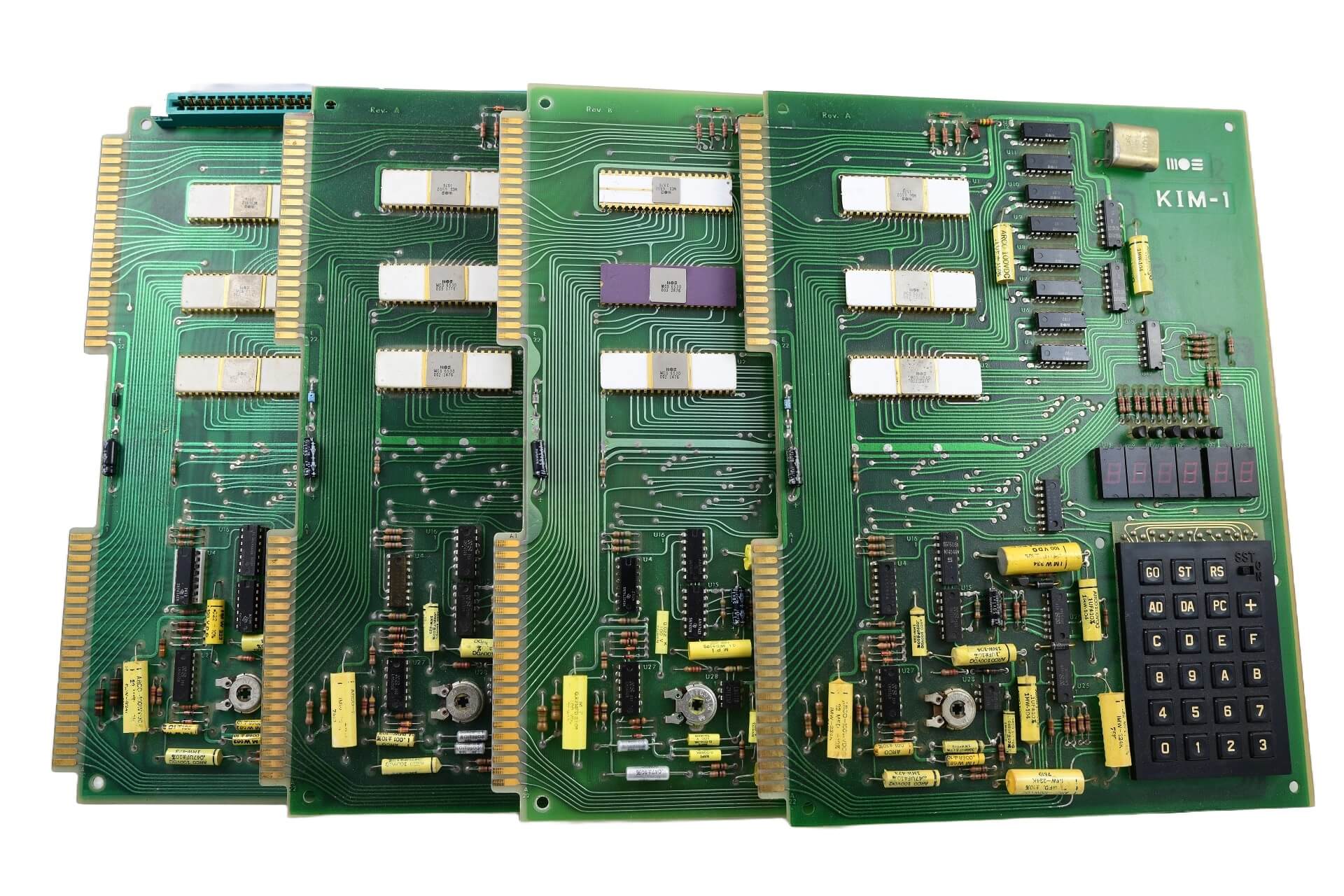 +
Some of my KIM-1
+
Some of my KIM-1
I own some KIM-1 and luckily some of the first edition with ceramic chips
KIM-1: The Single-Board Computer That Sparked a Revolution
The KIM-1 (Keyboard Input Monitor) is a legendary single-board computer that helped launch the microcomputer age. Released by MOS Technology in 1976, the KIM-1 was created to showcase the new 6502 microprocessor in an affordable and practical way.
With its simple design, which included a 6502 CPU, one kilobyte of RAM, a hexadecimal keypad, and a six-digit LED display, the KIM-1 gave engineers, students, and hobbyists real access to computing power. Users could enter programs directly in machine code and store them on standard cassette tapes.
For many early computer enthusiasts, the KIM-1 was their first experience building, programming, and expanding a microcomputer. Clubs, magazines, and user communities formed around it and shared programs and hardware ideas.
The KIM-1’s influence reached far beyond its original board. It helped make the 6502 processor popular, which later powered iconic computers such as the Apple II, the Commodore PET, and the NES gaming console.
Today, the KIM-1 is an important piece of computer history and is highly valued by collectors and vintage computing fans. Its legacy reminds us that a simple and affordable board can inspire innovation and shape an entire industry.
Micro-68 (1976)
A Hobbyist’s Introduction to the Motorola 6800
The Micro-68 is an early microcomputer kit that helped introduce many electronics enthusiasts to the Motorola 6800 microprocessor. Sold as a do-it-yourself kit during the mid to late 1970s, the Micro-68 provided an affordable way for hobbyists and students to build their own computer and learn about microprocessor technology firsthand.
The Micro-68 was based on the Motorola 6800, one of the first 8-bit microprocessors available to the public. The kit included a circuit board, sockets for the processor and supporting chips, and basic input and output connections. Many users built simple systems with a hexadecimal keypad for entering data and a small LED or seven-segment display for output.
One of the Micro-68’s main attractions was its simplicity and expandability. Once assembled, users could add memory boards, serial interfaces, and connections for tape storage. Many early adopters used the Micro-68 to learn assembly language, experiment with machine-level programming, and design custom circuits.
The Micro-68 is an example of the hands-on spirit of early personal computing. It appealed to the same generation of hobbyists who built machines like the Altair 8800 and IMSAI 8080, and it contributed to the spread of computer literacy at a time when fully assembled computers were still rare and expensive.
Today, the Micro-68 holds a special place in the history of early microcomputers. It is valued by collectors and vintage computing museums as an example of how kit computers helped people understand the basics of computing and inspired the engineers who would go on to shape the industry.
Motorola MEK6800D2 Microcomputer (1976)
The Motorola MEK6800D2 Microcomputer is an important piece of computing history that introduced thousands of engineers and students to the power of microprocessors. Developed by Motorola in the mid-1970s, the MEK6800D2 served as both a demonstration system and a practical development kit for the popular Motorola 6800 microprocessor.
The MEK6800D2 was designed as a single-board microcomputer. It included the Motorola 6800 CPU, RAM and ROM chips, a hexadecimal keypad for direct data input, and a simple LED display for output. Users could enter machine code instructions, run programs, and see the results immediately, providing an invaluable hands-on learning experience.
Motorola supplied the MEK6800D2 to engineers, technicians, and educational institutions to help them understand the capabilities of the 6800 chip and to develop new applications. The kit often came with detailed manuals and sample programs, giving users step-by-step guidance for exploring the microprocessor’s features.
The 6800 family of processors, which the MEK6800D2 showcased, became widely used in early computing, industrial control systems, and embedded electronics. Many engineers who trained on the MEK6800D2 later contributed to the design of consumer products, industrial equipment, and early home computers.
For students and hobbyists, the MEK6800D2 offered a clear window into how microprocessors execute instructions and interact with memory and input/output devices. Its straightforward design made it a trusted tool for practical experimentation at a time when microcomputing was still new and rapidly evolving.
Today, the Motorola MEK6800D2 is recognised as a classic microcomputer trainer and a milestone in the history of computer engineering education. It represents the era when learning about microprocessors meant building circuits, writing machine code by hand, and seeing technology come to life in real time.
SOL-20 (1976)
One of the First True Personal Computers
The Sol-20 is one of the most important early personal computers and a true milestone in the history of home computing. Released by Processor Technology in 1976, the Sol-20 brought together many features that helped define what a personal computer could be.
The Sol-20 was designed by computer pioneer Lee Felsenstein. It was one of the first computers to combine a keyboard and video display output in a single ready-to-use unit. This was a big step forward at a time when many computers were sold only as kits and often required users to add their own keyboard and display connections.
The Sol-20 used the popular S-100 bus standard and an Intel 8080 microprocessor, which made it compatible with many other parts and expansions that hobbyists and small businesses used at the time. Users could connect the Sol-20 to a TV or monitor and type directly on its built-in keyboard, making it much more practical for everyday use.
Many early computer users praised the Sol-20 for its stylish wooden side panels and its solid build quality. It became a favourite in computer clubs and among early personal computer enthusiasts.
Although only a few thousand Sol-20 computers were made, it influenced the design of later home computers that combined all essential parts into one unit. Many people who first learned about computing on the Sol-20 went on to become engineers, programmers, and leaders in the growing computer industry.
Today, the Sol-20 is a prized collector’s item and an important part of computing history. In museums, it shows visitors how the idea of a complete personal computer began to take shape and inspire the machines we use every day.
Texas Instruments Microprogrammer LCM-1001 (1976)
The Texas Instruments Microprogrammer LCM-1001 is a specialized educational microprocessor trainer designed to introduce students and engineers to the fundamental concepts of microprogramming and computer architecture. Released in the early 1970s, the LCM-1001 provided a hands-on learning platform at a time when microprocessors were just emerging as revolutionary technology.
Developed by Texas Instruments, a leading innovator in semiconductor technology, the LCM-1001 focused on teaching the principles of microprogram control, a method used in CPUs to execute instructions at a very low hardware level. Microprogramming was a key technique in early computer design, helping to simplify control logic and enable more flexible instruction sets.
The LCM-1001 featured an array of switches, lights, and simple input/output devices that allowed users to write, test, and debug microcode routines directly. This direct interaction gave learners valuable insight into how a processor manages its internal control signals and coordinates complex instruction execution.
Primarily used in academic settings, technical institutes, and training centers, the Microprogrammer LCM-1001 helped bridge the gap between theoretical computer science and practical engineering. Its design encouraged experimentation with instruction sequencing, control store programming, and timing analysis.
Today, the Texas Instruments Microprogrammer LCM-1001 is regarded as an important educational tool from the dawn of the microprocessor era. It illustrates how foundational knowledge in microprogramming contributed to the development of modern CPUs and remains a significant exhibit for museums chronicling the history of computer engineering.
Christiani SC/MP (1977)
The Christiani SC/MP is a microprocessor training system developed in Germany during the late 1970s. Created by Christiani, a respected supplier of educational tools and training equipment, the SC/MP trainer helped teach thousands of students the basics of microprocessor technology at a time when the microcomputer revolution was still in its early stages.
At the heart of the trainer is the SC/MP microprocessor, which stands for Simple Cost-effective Micro Processor. Produced by National Semiconductor and introduced in 1976, the SC/MP was one of the first affordable microprocessors that made it possible for schools and hobbyists to explore how a microprocessor works. It gained popularity in Europe for its simplicity and ease of use in educational projects.
The Christiani SC/MP trainer featured a circuit board with the processor, RAM and ROM chips, a hexadecimal keypad for direct data entry, and a simple LED display for viewing outputs. Students could write machine code programs, enter them one step at a time, and observe how the processor executed instructions. This practical approach was invaluable for understanding programming, digital logic, and basic computer architecture.
Christiani supplied the SC/MP trainer to vocational schools, technical colleges, and industrial training centers across Germany and beyond. It formed an important part of the curriculum for electronics and computer engineering students. The kit was often accompanied by detailed manuals, exercises, and practical tasks that guided students through the fundamental concepts of microprocessor operations.
For many students and teachers, the Christiani SC/MP was their first experience working hands-on with a real microprocessor. It offered a clear window into how computers process data and laid the foundation for later study and work in computing and electronics.
Today, the Christiani SC/MP trainer is an important piece of European educational history and remains a valued item for collectors and museums interested in the roots of microprocessor education.
IMSAI 8048 (1977)
A Versatile Microcontroller Trainer and Development System
The IMSAI 8048 is a lesser-known but fascinating part of IMSAI’s lineup of early computing products. Released in the late 1970s, the IMSAI 8048 was designed as a development and training system for the Intel 8048 microcontroller family.
While the famous IMSAI 8080 focused on general-purpose computing and hobbyist use, the IMSAI 8048 targeted engineers, students, and companies that needed to develop and test embedded systems. The Intel 8048 microcontroller was widely used in industrial equipment, appliances, and early embedded electronics.
The IMSAI 8048 offered a compact and practical way to learn how to program and interface the 8048 microcontroller. It featured a simple keyboard and display, input and output ports, and an accessible design that made it easy to connect additional hardware. This made it a useful tool for training new engineers and for building and testing prototypes.
Unlike larger computers, the IMSAI 8048 focused on real-time control and simple tasks that required reliability and low power consumption. Its use helped spread knowledge about embedded systems at a time when microcontrollers were just beginning to find their way into consumer and industrial products.
Today, the IMSAI 8048 is remembered as a good example of how early microcomputers and microcontroller trainers supported education and innovation. It is an interesting artifact for museums and collectors who want to tell the story of how computing left the desktop and entered the world of everyday devices.
Intel MCS-85 / SDK-85 (1977)
The Intel MCS-85 is the name for Intel’s complete microcomputer system built around the famous Intel 8085 microprocessor, which debuted in 1976 as an improved successor to the 8080 chip. To help engineers, students, and designers learn how to use the 8085 in real-world applications, Intel created the SDK-85, a practical and accessible development kit.
SDK stands for System Design Kit. The SDK-85 was designed as a compact training and prototyping system that let users program the 8085 directly, observe how instructions were executed, and test ideas for circuits and embedded applications.
The SDK-85 featured the 8085 CPU, RAM and ROM memory, a simple hexadecimal keypad for direct data entry, and an LED display for viewing addresses and data. Users could write programs in machine code or assembly, enter them step by step, and run them to see exactly how the processor worked.
Intel included clear documentation, sample programs, and exercises with the SDK-85, making it popular in technical colleges, engineering labs, and training courses. It was also used by hobbyists and early microcomputer enthusiasts to understand microprocessor principles and practice low-level programming skills.
The MCS-85 family went far beyond the processor itself. It included supporting chips, peripherals, and design resources that helped developers create early embedded systems and industrial controllers. Many early products in communications, instrumentation, and control were based on the robust and simple MCS-85 architecture.
Today, the SDK-85 is remembered as an important milestone in the history of microprocessor education and development. It provided an affordable and practical way to explore the power of 8-bit microcomputing — laying the groundwork for countless innovations that followed.
Nascom 1 (1977) and Nascom 2 (1979)
The NASCOM 1 and NASCOM 2 are iconic examples of early British microcomputers that gave thousands of enthusiasts hands-on experience with building and programming their own machines. Produced by NASCOM Microcomputers Ltd and first released in 1977, these kits were especially popular among hobbyists, students, and electronics clubs across the United Kingdom and Europe.
The original NASCOM 1 was sold as a self-assembly kit. It featured a Zilog Z80 microprocessor, a full ASCII keyboard, a built-in video output for connecting to a TV or monitor, and simple input/output ports for expansion. With 2 kilobytes of RAM (expandable) and a built-in monitor program in ROM, users could get started right away by entering machine code or BASIC programs.
The NASCOM 1 quickly earned a reputation for its rugged design and excellent documentation, which made it easier for beginners to build, troubleshoot, and expand. For many, it was their first real step into the world of microcomputing.
The NASCOM 2, released in 1979, built on the success of its predecessor. It added more memory, improved video output, and enhanced expandability with better interfaces for storage, printers, and other peripherals. It kept the same Z80 processor, which was popular among hobbyists at the time. The NASCOM 2’s improved features made it a practical choice for more advanced applications such as programming, word processing, and early home automation.
Both the NASCOM 1 and NASCOM 2 created a dedicated community that published magazines, software, and hardware add-ons. Many users learned valuable skills that led to careers in electronics and computing.
Today, the NASCOM computers are treasured by collectors and vintage computing museums. They represent the spirit of the DIY computer revolution and remind us of a time when learning to solder and program your own machine was part of the excitement of owning a computer.
Polymorphic S-100 (1977)
The Polymorphic S-100 was an influential microcomputer system built around the S-100 bus architecture, which was a widely adopted industry standard in the mid to late 1970s. Manufactured by Polymorphic Systems, Inc., the system offered users a versatile and expandable platform ideal for both hobbyists and professional users.
Introduced in the late 1970s, the Polymorphic S-100 capitalized on the modular design of the S-100 bus, allowing users to configure the system with various CPUs, memory boards, and peripheral cards according to their needs. The bus supported multiple 8-bit and later 16-bit processors, providing flexibility for different computing tasks.
One of the defining features of Polymorphic Systems was the inclusion of high-quality hardware and innovative design choices that enhanced reliability and performance. The Polymorphic S-100 systems were often equipped with the Intel 8080 or Zilog Z80 processors, popular microprocessors of the era, and could run CP/M, the leading operating system for early microcomputers.
The Polymorphic S-100 found use in business applications, data acquisition, laboratory control, and software development. Its expandability and compatibility with a wide range of S-100 peripherals made it a favourite among early computer enthusiasts and professionals.
Today, the Polymorphic S-100 stands as a testament to the versatility and innovation of early microcomputing. It represents a key phase in the transition from single-board computers to fully modular and upgradeable systems, laying groundwork for modern personal and industrial computers.
RCA Super ELF (1977)
An Iconic Trainer for the RCA 1802 Microprocessor
The RCA Super ELF is a classic example of an early hobbyist computer kit that gave many enthusiasts their first experience with microprocessors. Introduced in the late 1970s, the Super ELF was based on the RCA CDP1802 microprocessor, a unique and reliable chip that found its way into everything from experimental computers to spacecraft.
The Super ELF evolved from the original Popular Electronics ELF project, which appeared in a 1976 magazine article that showed readers how to build a simple computer using the RCA 1802. The Super ELF, sold as a more advanced kit by Netronics Research and Development, offered extra features that made it more powerful and practical for serious experimenting.
The kit typically included a hexadecimal keypad, LED displays, RAM, and a monitor program in ROM that let users input and run their own code. Many users connected the Super ELF to a television for video output, adding a simple display for running games and programs. The design was modular, so users could add memory expansion, serial ports, or even cassette tape storage to save and load programs.
One of the reasons the RCA Super ELF stands out is the 1802 processor itself. The chip was popular because of its low power consumption and simple, robust design. It was even used in NASA spacecraft, making it one of the few microprocessors that literally went to space.
For hobbyists, the Super ELF offered an affordable and hands-on way to learn about machine code, microprocessor logic, and basic digital electronics. It helped inspire a generation of computer builders who enjoyed the challenge of soldering boards and writing low-level software.
Today, the Super ELF is remembered fondly by collectors and vintage computer fans. It represents the early days when computing was a do-it-yourself adventure, driven by curiosity, creativity, and the excitement of building a working computer from a handful of chips and wires.
Science of Cambridge MK-14 (1977)
A Pioneering British Microcomputer Kit
The Science of Cambridge MK-14 is one of Britain’s earliest and most affordable microcomputer kits, created to introduce hobbyists to the new world of personal computing. Launched in 1977 by Science of Cambridge Ltd, the company founded by Sir Clive Sinclair, the MK-14 became a stepping stone for a generation of future engineers and computer enthusiasts.
The MK-14 was based on the National Semiconductor SC/MP microprocessor and offered a simple but practical design. It came as a self-assembly kit with a small hexadecimal keypad, a numeric LED display, and a few kilobytes of RAM. Users could enter machine code programs directly and watch the results on the display, providing a direct and educational way to understand how microprocessors work.
What made the MK-14 so important was its low cost and accessibility. While many microcomputers of the time were expensive and out of reach for most hobbyists, the MK-14 brought computing to people who were willing to learn how to solder and experiment.
The MK-14’s success inspired Clive Sinclair to create even more advanced and affordable computers, which would later include the famous ZX80 and ZX81, and ultimately the Sinclair Spectrum, one of the most influential home computers of the 1980s.
Although simple by modern standards, the MK-14 is a landmark in British computing history. It helped ignite the UK’s vibrant home computer industry and taught thousands of people the basics of programming and hardware design.
Today, the MK-14 is a prized collector’s item and a symbol of the early days when personal computing was still a hands-on adventure filled with curiosity and invention.
SuperJOLT (1977)
The SuperJOLT is not as rare as the JOLT but still very rare. It has been in my collection since 2022.
A Rare Example of Early Single-Board Computers
The SuperJOLT is a lesser-known but fascinating piece of early microcomputer history. Designed in the late 1970s by Microcomputer Associates Inc., the SuperJOLT was part of a wave of affordable, simple computers that gave hobbyists hands-on experience with microprocessor technology.
The SuperJOLT was based on the MOS Technology 6502 microprocessor, the same chip found in famous computers like the Apple I, Apple II, and Commodore PET. It was sold as a compact single-board computer, making it both affordable and easy to experiment with.
This small computer came with a simple design that made it ideal for learning about programming and hardware. Users could connect a terminal or teletype and write programs in machine language or BASIC. Because of its open design, the SuperJOLT was often used as the core for custom projects, educational tools, and experiments in electronics labs.
Although the SuperJOLT never reached the popularity of larger systems, it played an important role in making microcomputers more accessible to students, hobbyists, and engineers. It showed how a complete computer could be built around a single small board, a concept that influenced later hobbyist computers and development kits.
Today, surviving SuperJOLT boards are rare and treasured by collectors of vintage computing. They stand as reminders of a time when curiosity, soldering irons, and a simple circuit board could open the door to an entire world of computing.
Vector-1 (1977)
The Vector 1 is a notable example of the early generation of S-100 bus computers that helped shape the homebrew and small business computing scene of the late 1970s. Produced by Vector Graphic Inc., a pioneering microcomputer company founded in 1976 in California, the Vector 1 gave hobbyists and professionals a reliable and expandable computing system at a time when personal computers were just beginning to find their place in offices and homes.
The Vector 1 was based on the popular Intel 8080 microprocessor and used the S-100 bus standard, which allowed users to add memory cards, disk controllers, and other expansion boards as their needs grew. It came as either a kit for advanced hobbyists or fully assembled for small businesses that wanted an out-of-the-box computing solution.
One of the key features that set the Vector 1 apart from other S-100 systems was its build quality and thoughtful engineering. Vector Graphic offered sturdy metal enclosures, reliable power supplies, and quality circuit boards that made their machines durable and well respected among early computer enthusiasts.
Many Vector 1 systems were used for programming in BASIC, data processing, word processing, and business applications. Users often paired the Vector 1 with CP/M, the dominant microcomputer operating system of the era, which opened up a wide range of available software.
The Vector 1 helped establish Vector Graphic as one of the trusted names in the early microcomputer industry. The company went on to produce more advanced systems like the Vector 3 and Vector 4 before the industry shifted toward fully integrated personal computers like the IBM PC.
Today, the Vector 1 is prized by collectors and vintage computing museums as a strong example of the S-100 bus era. It reminds us of a time when the personal computer world was built by small companies, creative engineers, and dedicated hobbyists who laid the groundwork for modern computing.
Cromemco System Three (1978)
The Cromemco System Three is a modular microcomputer system introduced by Cromemco in 1978. It was designed to meet the needs of businesses, engineers, and hobbyists requiring a flexible, expandable, and powerful computing platform during the early era of personal computers.
Building on Cromemco’s reputation for robust hardware and innovative designs, the System Three offered a stackable chassis that could accommodate multiple circuit boards. This design allowed users to customize their system with CPUs, memory, storage controllers, and input/output cards tailored to their specific applications.
At its core, the System Three typically used the S-100 bus architecture, a popular industry standard for microcomputer expansion at the time. This compatibility provided a broad range of peripheral options and made it easier to upgrade or adapt the system.
Equipped with a built-in power supply and versatile I/O capabilities, the System Three supported floppy disk drives, serial and parallel ports, and could connect to CRT displays or printers. The system was often used for data processing, engineering tasks, programming, and early computer-aided design (CAD).
Cromemco was well-known for its pioneering graphics cards and other innovations, and the System Three could be enhanced with their advanced graphics options, making it attractive for technical and scientific applications.
The Cromemco System Three represents an important step in the evolution of microcomputers, bridging the gap between hobbyist kits and professional computer systems. It remains a valuable artifact in computing history, showcasing modular design and expandability long before such features became standard in personal computers.
DPS-1 (1978)
The DPS-1 is an early microcomputer system introduced in 1978, designed to provide users with a flexible and expandable platform for computing and development tasks during the formative years of personal computing.
Built around popular microprocessor architectures of the time, the DPS-1 was often based on the Intel 8080 CPU and utilized the S-100 bus standard, which allowed for modular expansion and customization. This design made it popular among hobbyists, educators, and professionals seeking a versatile machine for programming, data processing, and control applications.
The DPS-1 featured multiple expansion slots, enabling the addition of memory boards, storage controllers, and input/output devices. It typically supported floppy disk drives and could operate with early operating systems such as CP/M, offering users access to a growing library of software.
During the late 1970s, systems like the DPS-1 were instrumental in transitioning computing from large mainframes and minicomputers to accessible personal machines. Its modularity and capability to be tailored for specific tasks reflected the evolving needs of early computer users.
Today, the DPS-1 remains an important example of early microcomputer engineering, representing the innovation and adaptability that characterized the dawn of the personal computing era.
Dynabyte DB 8/2 (1978)
The Dynabyte DB 8/2 was an early microcomputer system developed in the late 1970s. Known for its flexibility and modular design, the DB 8/2 was aimed at both industrial applications and hobbyists interested in emerging personal computing technology.
The system featured an 8-bit processor, which provided sufficient computing power for a variety of tasks including data processing, control applications, and educational purposes. Its modular architecture allowed users to expand memory and add peripherals according to their needs.
With its combination of expandability and affordability, the Dynabyte DB 8/2 offered a practical solution during a period when microcomputers were just beginning to gain popularity outside of large institutions. It supported programming in assembly language and offered basic input/output capabilities suitable for early computing projects.
Today, the Dynabyte DB 8/2 is recognised as part of the foundational era of microcomputing, demonstrating how early systems balanced performance and user customization. It is preserved in computing collections as an example of the innovation and experimentation that characterized the microcomputer revolution.
E & L Instruments Mini Micro Designer MMD-1 (1978)
The E & L Instruments Mini Micro Designer MMD-1 is a microcomputer development system introduced in 1978. Designed for engineers, educators, and hobbyists, the MMD-1 provided a practical platform for programming, testing, and experimenting with microprocessor technology during the early era of personal computing.
The system was built around popular microprocessor architectures of the time, often featuring the Intel 8080 or similar CPUs. It was designed to facilitate hands-on learning and development, with a focus on microprocessor instruction execution, memory management, and input/output interfacing.
Featuring a compact design, the MMD-1 included a hexadecimal keypad for data entry, LED displays for immediate feedback, and various expansion options. These features allowed users to write machine code programs directly, making the system ideal for teaching and prototyping microprocessor-based projects.
The Mini Micro Designer MMD-1 was used extensively in educational settings and small laboratories, supporting the growing interest in microprocessor technology and embedded systems development. It offered a valuable bridge between theoretical concepts and practical applications.
Today, the E & L Instruments Mini Micro Designer MMD-1 stands as a testament to the pioneering spirit of early microcomputer development tools. It remains a significant artifact illustrating how accessible training systems helped shape the skills and knowledge of the next generation of computer engineers.
OS Model 600 (1978)
The OS Model 600 is an interesting and lesser-known microcomputer from the early days of personal and educational computing in the United Kingdom. Produced by the company Office Supplies Ltd (OS) during the late 1970s or early 1980s, the Model 600 was designed as an affordable and practical computer for schools, small businesses, and hobbyists who wanted to explore computing for the first time.
The Model 600 featured a compact design that included a built-in keyboard and could connect to a standard television or monitor for display. It typically used an 8-bit microprocessor such as the Zilog Z80 or a similar chip, which was common among British microcomputers of the era. The machine often shipped with a BASIC interpreter stored in ROM, giving users the ability to write, test, and run their own programs straight out of the box.
Like other early microcomputers, the OS Model 600 relied on cassette tapes for data storage. Users could load programs and save their own work using standard tape recorders. While simple by today’s standards, this made the system affordable and easy to use for beginners.
The Model 600 contributed to the spread of computer literacy at a time when the idea of having a computer at home or in the classroom was still new and exciting. It competed with other early British micros like the Sinclair ZX80, the BBC Micro, and the Compukit UK-101.
Today, the OS Model 600 is a rare find for collectors and vintage computing fans. It represents an important period when small companies around the world were experimenting with ways to bring computers to homes and schools, helping to lay the foundation for the widespread use of personal computers that soon followed.
Sharp MZ-40K (1978)
The Sharp MZ-40K is a notable piece of computing history that introduced many enthusiasts and students to the world of microcomputers and programming. Released by Sharp Corporation in 1978, the MZ-40K is a simple yet clever microcomputer kit designed for hobbyists and beginners.
Unlike a fully assembled personal computer, the MZ-40K was sold as a self-assembly kit. Users learned basic electronics by putting the machine together themselves. This hands-on approach taught not only how computers work internally but also how microprocessors interact with memory and input-output devices.
At the heart of the MZ-40K is the Sharp SC/MP-compatible microprocessor, which made it affordable and easy to understand. The computer featured a hexadecimal keypad for entering instructions and an LED display for showing results. Users could write small programs directly in machine code and run them step by step to see exactly how the processor executed each instruction.
The MZ-40K did not have a keyboard or a screen like later home computers but instead used simple lights and switches to demonstrate fundamental computer operations. It was designed as an educational tool, helping users grasp the basics of programming, binary numbers, and digital logic.
The MZ-40K holds a special place in the Sharp MZ series, which went on to include more advanced models like the MZ-80K and MZ-700. These later machines offered keyboards, monitors, and cassette storage, but it was the humble MZ-40K that sparked the curiosity of early computer hobbyists and laid the groundwork for more complex systems.
Today, the Sharp MZ-40K is valued by collectors and museums as an early example of a do-it-yourself microcomputer kit. It stands as a reminder of an era when learning to build and program a computer from scratch was the best way to understand how these revolutionary machines worked.
Signetics Instructor 50 (1978)
Training Tool for Learning Microprocessor Technology
The Signetics Instructor 50 is an early educational microprocessor trainer developed by Signetics in the late 1970s. Designed to teach students and engineers how to program and work with the Signetics 2650 microprocessor, the Instructor 50 played an important role in microprocessor education during the early years of embedded systems and personal computing.
Compact and practical, the Instructor 50 included a simple keyboard, a small display, and a front panel with switches and indicator lights. Students could enter machine code instructions directly and see how the processor executed each step in real time. This hands-on approach made it possible to understand how data moved through the processor and how programs controlled hardware.
The Signetics 2650 itself was used in early arcade machines, control systems, and other embedded applications. With the Instructor 50, engineers and students could experiment with the same chip and gain valuable experience in programming, debugging, and hardware interfacing.
The Instructor 50 became a popular choice in technical schools and training centers, helping thousands of people develop the skills needed to work with the rapidly growing world of microprocessors.
Today, the Signetics Instructor 50 is a fascinating reminder of the era when learning about computers meant working directly with low-level machine code and hardware circuits. Museums and collectors value it for its role in shaping the first generation of microprocessor engineers who helped drive the computer revolution forward.
Compukit UK-101 (1979)
A Classic British Home Computer Kit
The Compukit UK-101 is an iconic example of the early days of home computing in Britain. Introduced in 1979, the UK-101 was sold as a kit through Practical Electronics magazine, offering hobbyists an affordable way to build and own their own computer.
The UK-101 was based on the MOS Technology 6502 microprocessor, the same chip that powered other famous computers like the Commodore PET and the Apple I. The kit came with a circuit board, components, and clear instructions, allowing users to solder and assemble the computer themselves. For many people, this was their first hands-on experience with computer hardware.
Once built, the UK-101 featured a built-in keyboard, 8 kilobytes of RAM (expandable), and could connect to a TV for display output. Users could write and run programs in BASIC or machine code, and could add peripherals like cassette storage for saving and loading software.
The UK-101 inspired a generation of British computer enthusiasts and engineers. It showed how home computing could be accessible and educational at a time when fully assembled computers were expensive and often out of reach for hobbyists.
Today, the Compukit UK-101 is a beloved piece of computing history. Museums and collectors admire it for its role in sparking Britain’s vibrant home computing scene, which would later give rise to famous machines like the Sinclair ZX80, BBC Micro, and many others.
Intel SBC 86/12A (1979)
A Milestone in 16-bit Embedded Computing
The Intel iSBC 86/12A was introduced in 1979 as part of Intel's industrial-grade line of single-board computers. Designed for use in embedded systems, instrumentation, and process control, the board offered a complete computing platform on a single card and was fully compatible with the Multibus architecture, Intel’s modular bus system developed for expandable computing systems.
At the heart of the iSBC 86/12A was the Intel 8086 microprocessor, a 16-bit CPU capable of operating at up to 5 MHz. This processor brought significant improvements in performance and memory addressing over earlier 8-bit designs. The board came equipped with 32 kilobytes of dynamic RAM, with expansion support up to 64 kilobytes using additional memory modules. Up to 16 kilobytes of user-installed ROM or EPROM could be integrated for permanent program storage.
The iSBC 86/12A featured a rich set of input and output capabilities, making it suitable for a wide range of real-world applications. A built-in serial interface using Intel's 8251A allowed for both synchronous and asynchronous communication, commonly used with RS-232 terminals or peripheral devices. For parallel interfacing, the board included 24 programmable I/O lines using the Intel 8255A programmable peripheral interface. These lines could be configured for input or output in various combinations, ideal for controlling sensors, displays, or actuators.
Timing and control functions were handled by three 16-bit programmable timers, implemented using the Intel 8253 chip. For managing complex operations and peripheral communication, the board included the Intel 8259A programmable interrupt controller. This enabled the system to respond to multiple sources of interrupts efficiently, a critical feature for real-time and multitasking environments.
The iSBC 86/12A supported full Multibus functionality and could operate as a bus master or as a dual-port slave memory device. This flexibility allowed it to be integrated into complex computing systems where multiple boards shared responsibilities such as data acquisition, control processing, and communication.
The release of the iSBC 86/12A marked a key moment in the transition from large, centralized computing systems to smaller, more modular embedded designs. Unlike general-purpose personal computers, this board was intended for use in industrial and scientific environments where reliability, expandability, and deterministic control were essential.
Today, the Intel iSBC 86/12A is an important artifact in the history of embedded computing. It exemplifies how early 16-bit microprocessors were used not just in desktop machines but also in the embedded systems that quietly powered manufacturing equipment, laboratory instruments, and communications devices. Its design reflects Intel’s leadership in offering high-performance computing solutions well before the era of the modern PC.
Intel SDK-86 (1979)
The Intel SDK-86 is a classic microprocessor development kit that played an important role in introducing engineers and students to Intel’s powerful 8086 microprocessor. Released by Intel around 1979, the SDK-86 gave programmers and designers a practical way to experiment with 16-bit computing at a time when the industry was shifting from 8-bit to more advanced architectures.
SDK stands for System Design Kit, and the SDK-86 was designed as both a teaching tool and a development platform. It featured the Intel 8086 CPU — the same processor family that would later form the basis of the IBM PC and set the standard for modern personal computers.
The SDK-86 included a single circuit board with the 8086 processor, RAM and ROM chips, a simple hexadecimal keypad for direct program entry, and a numeric LED display for showing addresses and data. Users could write machine code instructions, enter them by hand, and step through program execution to watch how the processor handled data, addresses, and instructions.
In addition to hardware, Intel provided detailed manuals, sample programs, and exercises with the SDK-86. Many engineering schools, technical colleges, and industrial training centers used this kit to teach students the principles of 16-bit programming, assembly language, and system design.
The SDK-86 was also used by hardware and software developers to prototype new applications, test programs, and design peripherals that used the 8086 processor. It helped bridge the gap between theoretical knowledge and practical design skills at a time when microprocessors were rapidly changing the electronics industry.
Today, the Intel SDK-86 is remembered as a significant tool from the early days of personal computing and embedded system design. For collectors and museums, it represents a key step in the evolution of computing from simple 8-bit microprocessors to the 16-bit systems that shaped the future of PCs.
ITT MP Experimenter 8080 (1979)
The ITT MP Experimenter 8080 is an educational microprocessor trainer designed to teach students, engineers, and electronics enthusiasts how to program and work with the Intel 8080 microprocessor. Developed in the late 1970s by ITT, a major European electronics company, the MP Experimenter reflects a time when practical, hands-on training was essential for understanding this new field of microprocessor technology.
At its core, the MP Experimenter 8080 is built around the Intel 8080, one of the earliest and most influential microprocessors. Introduced by Intel in 1974, the 8080 powered many early computers, including the famous Altair 8800. With the MP Experimenter, learners could explore how this processor executes instructions, handles memory, and controls input and output devices.
The trainer featured a sturdy circuit board with the 8080 CPU, supporting RAM and ROM chips, a hexadecimal keypad for entering machine code, and a numeric LED display for viewing data and program results. Users entered instructions manually, then stepped through the program to see exactly how each operation was performed.
ITT designed the MP Experimenter 8080 for technical colleges, engineering schools, and industrial training centers. It was widely used in Europe to give students direct experience with microprocessor hardware and low-level programming — skills that were becoming increasingly valuable as microcomputers spread into business, industry, and research.
The trainer typically came with a detailed manual and exercises that guided students through basic programs, arithmetic operations, memory access, and input-output control. Many students who trained on the MP Experimenter 8080 went on to work with microprocessors in embedded systems, automation, and early personal computers.
Today, the ITT MP Experimenter 8080 is a respected educational tool from the pioneering days of microprocessor training. It remains a popular collector’s piece and a reminder of how practical kits helped shape the next generation of computer scientists and engineers.
Kienzle 1140-20 Taximeter (1979)
Well, not a 'classic' computer, but an embedded system with the iconic intel 4004. Of course, countless embedded systems with processors were manufactured. However, finding an Intel 4004 in a taximeter from 1979 is remarkable.
In 1979, the German company Kienzle Apparate introduced the 1140-20 taximeter, one of the earliest known commercial devices to integrate a microprocessor. This innovation marked a turning point in both automotive and embedded electronics history, as the device was powered by the Intel 4004, the world’s first commercially available single-chip microprocessor.
Originally introduced by Intel in 1971, the 4004 was designed to consolidate computing functions into a single integrated circuit. With a 4-bit architecture and approximately 2,300 transistors, the chip was capable of performing arithmetic and logic operations previously handled by more complex multi-chip systems. It was originally developed for calculators but quickly found new applications thanks to its small size, low power requirements, and programmable flexibility.
By embedding the 4004 into its taximeter, Kienzle took a bold step forward in fare calculation technology. Unlike traditional mechanical taximetres, which used gears, motors, and relays to compute fares based on time and distance, the 1140-20 used software instructions running on the microprocessor. This allowed it to adjust tariffs dynamically, respond to regional pricing models, and offer greater accuracy and reliability over time.
The taximeter used sensors to track the vehicle's speed and movement and combined that data with the elapsed time to compute the fare. The 4004 processed this information in real time, updating the display and logging the trip details. The use of a microprocessor also simplified maintenance and allowed updates through reprogramming rather than physical modification.
The Kienzle 1140-20 is one of the earliest documented examples of a microprocessor being used in an embedded control system for a commercial vehicle. It demonstrated how a microprocessor could replace complex mechanical systems with a programmable, compact, and efficient solution. This paved the way for the explosion of embedded systems in the decades to follow, from car dashboards and industrial controllers to household electronics.
Today, the Kienzle 1140‑20 stands as a landmark in the history of computing and electronics. It not only illustrates the practical use of the Intel 4004 beyond its original purpose, but also marks the beginning of a new era where computers quietly became part of everyday devices. For museums and historians, this taximeter is a symbol of technological transformation at the intersection of precision engineering and digital innovation.
MI-650C PROMAX (1979)
The Promax MI-650C, also known as the μ-Instructor, is a historically important microprocessor training system developed in Spain in 1979 by the company Promax. This trainer played a crucial role in educating generations of students, technicians, and engineers in the fundamentals of microprocessor programming and system design.
Built around the popular MOS Technology 6502 CPU, the MI-650C offered users a hands-on experience with one of the most influential microprocessors of the era. At a time when microcomputers were becoming essential in industry and education, the MI-650C provided a practical platform to learn machine code programming and hardware interfacing.
The trainer features a hexadecimal keypad for direct entry of machine instructions and an LED display for immediate feedback. It also includes expansion ports to connect peripherals, enabling more advanced experimentation. This setup allowed users to write and test programs step by step, fostering a deeper understanding of how microprocessors execute instructions and control devices.
Throughout the 1980s and 1990s, the MI-650C was widely used in vocational schools and technical colleges across Spain and Latin America. It helped bridge the gap between theoretical knowledge and practical skills at a time when hands-on learning was essential for careers in electronics and computing.
Today, the Promax MI-650C is preserved as an iconic example of early microprocessor education. It highlights the importance of accessible training tools in the development of computer technology expertise and remains a treasured exhibit for museums documenting the history of computing in Spain and beyond.
Northstar Horizon (1979)
The Northstar Horizon is an important early personal computer that helped shape the home and small business computing market in the late 1970s. First introduced by North Star Computers in 1977, the Horizon stood out as one of the first affordable computers to include a built-in floppy disk system, which was a major improvement over the paper tape and cassette storage of earlier machines.
The Horizon used the popular S-100 bus architecture and an Intel 8080 or Zilog Z80 microprocessor. Its sturdy wooden cabinet and modular design made it a practical choice for hobbyists, small businesses, and schools. With its floppy disk drives, users could store and retrieve programs and data more easily than ever before.
The Northstar Horizon came either as a kit or fully assembled. Many users loved that it could run the CP/M operating system, which made it compatible with a growing library of software for word processing, accounting, and programming.
Because of its expandability and reliable disk system, the Horizon became a favourite among early computer clubs and small companies that needed an affordable but powerful desktop computer. It demonstrated how useful a personal computer could be for serious work, not just experimentation.
Today, the Northstar Horizon is remembered as an early example of how accessible storage technology helped personal computing move from the hobbyist world into everyday offices and classrooms. It remains an important piece in many computer museums and collections, reminding visitors how practical ideas turned early microcomputers into real tools for work and learning.
Open University PT501 (1979)
The Open University PT501 is a fascinating example of how education embraced the microprocessor revolution. Developed by the Open University in the United Kingdom during the late 1970s and early 1980s, the PT501 was a microprocessor trainer kit designed specifically for teaching students the principles of computer architecture and programming.
The PT501 was based on the Motorola 6800 microprocessor, which was one of the most popular microprocessors of its time. The kit included a circuit board with the 6800 chip, RAM and ROM chips, a hexadecimal keypad for entering data and instructions, and a simple LED display for viewing results. This hands-on approach helped students understand exactly how a microprocessor processes instructions and handles data.
The Open University used the PT501 as part of its distance learning program for electronics and computing. Students received the trainer by mail, along with study materials and practical assignments. This unique teaching approach allowed thousands of learners to gain real-world experience with microprocessor hardware and low-level programming without having to attend a traditional classroom.
The PT501 also represented the educational philosophy of the Open University: to make higher education accessible to people who might not have access to conventional universities. By providing a practical, affordable trainer kit, the PT501 helped train a generation of engineers and computer scientists who would contribute to the rapid growth of the computing industry.
Today, the Open University PT501 is remembered as an important teaching tool and a symbol of how early computer education combined hands-on hardware with innovative distance learning. Vintage examples of the PT501 are now valued by collectors and museums as part of the story of how people first learned to program and build with microprocessors.
Polymorphic 8813 (1979)
The Polymorphic 8813 is a notable microcomputer system released by Polymorphic Systems, Inc. in 1979. Built around the widely used S-100 bus architecture, the 8813 provided users with a flexible and expandable computing platform during the early days of personal and business microcomputers.
The 8813 typically featured a powerful Zilog Z80 or Intel 8080 CPU, both popular processors at the time. Its modular design allowed for a variety of memory and peripheral cards to be added, making it suitable for a broad range of applications, from software development and data processing to industrial control.
Running the CP/M operating system, which was the de facto standard for 8-bit microcomputers, the Polymorphic 8813 supported a wide ecosystem of software and hardware. Its robust construction and reliable performance made it a favourite among professionals and enthusiasts who demanded a dependable system for complex tasks.
With expansion slots, serial and parallel ports, and options for disk drives, the Polymorphic 8813 was both adaptable and user-friendly. It reflected the trend of the late 1970s toward modular microcomputers that could grow with the user’s needs.
Today, the Polymorphic 8813 is recognised as an important piece of computing history, illustrating the evolution of microcomputer systems from hobbyist kits to professional machines that helped shape the modern computer industry.
IBM 5120 (1980)
A Practical Business Computer for Small Offices
The IBM 5120, introduced in 1980, was an important step in IBM’s early efforts to bring computing power to small businesses and professional offices. Building on the ideas behind the IBM 5100 and IBM 5110, the IBM 5120 offered more capacity, greater reliability, and an easier experience for users who needed serious computing without the cost and complexity of a mainframe.
The IBM 5120 featured a built-in 9-inch monochrome display, a full keyboard, and twin 8-inch floppy disk drives. It supported both APL and BASIC programming languages, allowing companies to run a wide range of custom business and scientific applications.
Designed mainly for accountants, engineers, and small office managers, the IBM 5120 provided enough computing power for tasks like accounting, inventory tracking, and data analysis. It was often used by small firms that wanted to automate tasks that once needed larger systems or manual bookkeeping.
While the IBM 5120 was not technically a personal computer in the way the later IBM PC would be, it played a vital role in making desktop computing practical and dependable for everyday business needs. It showed that computers could be compact, stand-alone systems that fit into an office environment without special facilities.
The IBM 5120 also demonstrated IBM’s effort to serve smaller customers who needed reliable computing on a manageable budget. In this way, it helped prepare the market for the massive success of the IBM PC, which followed only a year later.
Today, the IBM 5120 is remembered as a key part of IBM’s journey from mainframes to the personal computer era. Museums and collectors value it as an example of how computing moved closer to the desks of everyday workers and helped shape the modern office.
Commodore C65 (1991)
 +
Commodore C65
+
Commodore C65
By chance I got in touch with the owner of a Commodore C65. It's actually too young a computer for my collection, but its historical significance and rarity make it very interesting.
I flew to the USA to visit other collectors and as a holiday. I had to go to Pennsylvania to pick up this computer. This was an opportunity to visit the magnificent house Fallingwater designed by famous architect Frank Lloyd Wright. I would love a home like this.
The Commodore C65, also known as the Commodore 65 or C64DX, is one of the most fascinating “what-if” stories in the history of home computing. Designed in the late 1980s and early 1990s as a successor to the hugely popular Commodore 64, the C65 promised to push the classic 8-bit line further than ever before, but it never made it to store shelves.
By the late 1980s, Commodore was facing stiff competition from more advanced 16-bit computers like its own Amiga line and rivals like the Atari ST. Meanwhile, the beloved C64 was still selling well, but its technology was aging. To bridge the gap, Commodore engineers began developing the C65 as an affordable, more powerful follow-up that would be compatible with the C64’s huge software library but offer improved capabilities.
The goal was to appeal to C64 owners who wanted to upgrade without the cost or complexity of moving to a completely different platform like the Amiga.
Although the Commodore C65 never made it to market, its legacy lives on. Working prototypes occasionally appear at auctions and fetch high prices. In recent years, hobbyists and retro computing fans have reverse-engineered the C65’s hardware and software. One of the best-known projects is the Mega65, a modern open-source reimagining of what the C65 could have become — complete with updated hardware and new features while remaining true to its 8-bit roots.
In the end, the Commodore C65 represents a fascinating glimpse of what might have been — an ambitious attempt to keep the beloved 8-bit era alive just a little longer, at a time when technology was racing ahead into a new world of computing.
Confidential contact
If you own or know of a historically important computer, documentation, software, manuals, parts, photographs, provenance information or related artefacts, please contact me. Messages, photographs and provenance details are treated confidentially.