Q1 (1972)
The Q1 computer in Achim Baqué’s vintage computer collection.
Back to the Vintage Computer Collection
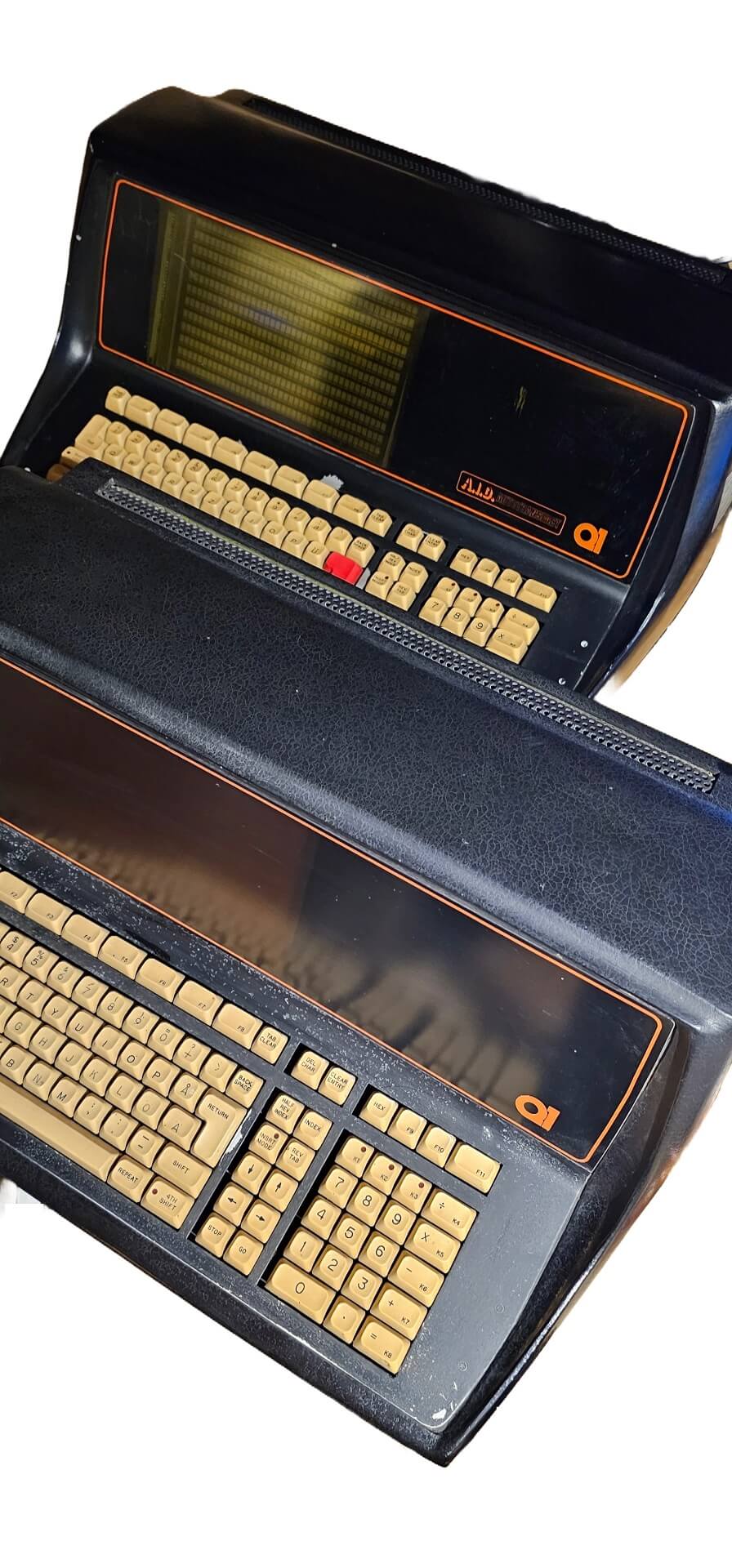
Strangely enough, the Q1 is hardly known. Unfortunately, this computer was poorly described in marketing and was therefore mainly used in offices.
The Q1 was way ahead of its time and was already offered in 1972 with a built-in multi-line display, a proper keyboard and a programmable computer in a small housing. There were also floppy disc drives and even hard drives to buy, and all this in 1972 - an absolute sensation, but unfortunately too unknown.
The guy in Sweden is a collector like me. He do not want to sell anything but a trade is possible. He was looking for a Datapoint 2200 and so I swapped one of Datapoint 2200 for the Q1.
It was the first time in a decade a Q1 was offered.
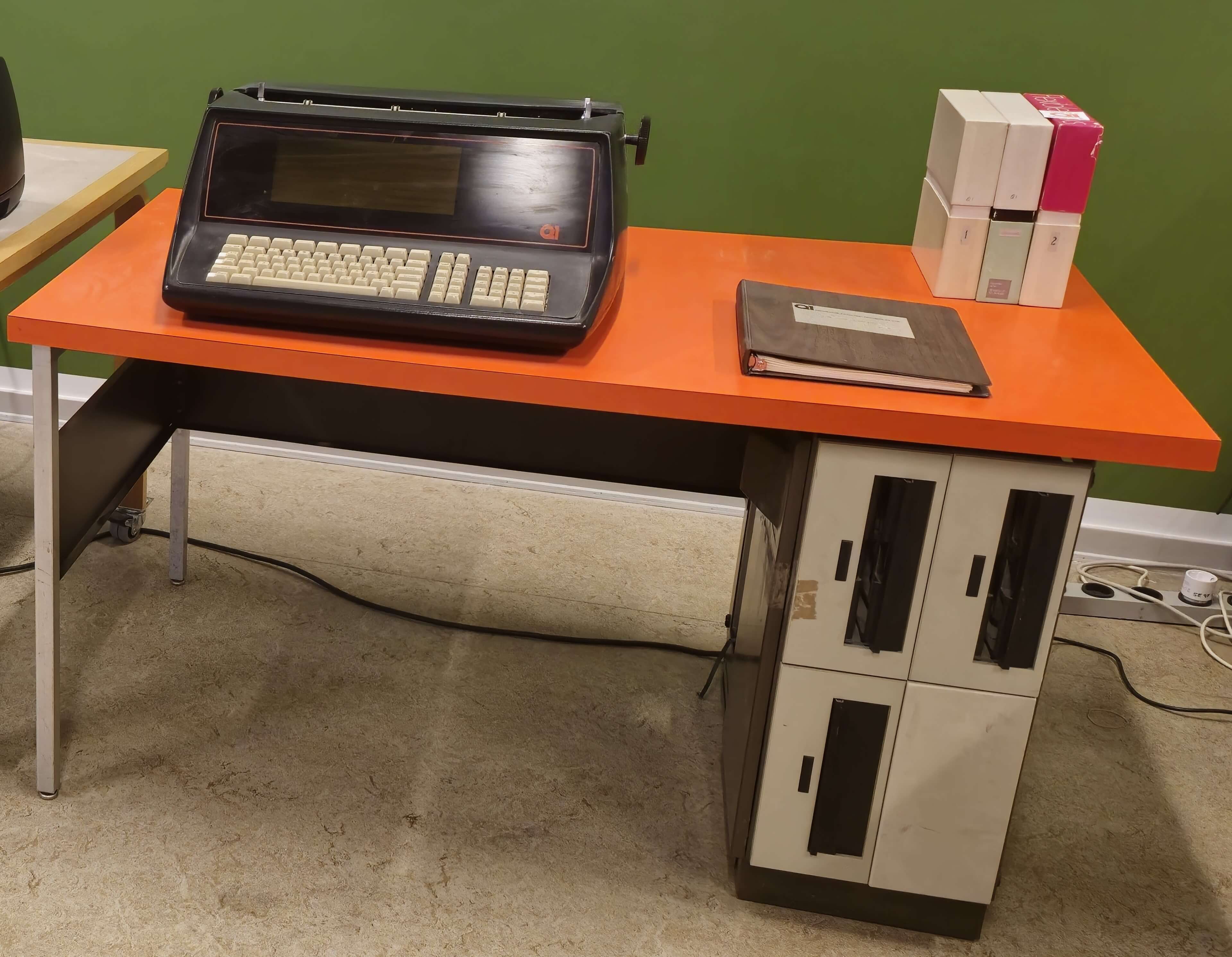
I got my first Q1 computer from a guy in Sweden. Complete with manuals, software, quadruple 8" disk drive, large hard disk and a table.
Shortly after this deal another Q1 showed up at eBay. After some negotiations I bought it.
Years later the guy in Sweden offered me another Q1 including software, manuals, quadruple 8" disk drive and a table.
This time I swapped it for one of my Olivetti Programma 101. We met in Denmark at the Dansk Datahistorisk Forening. The people in this museum invited us to swap the computer there.
Previously, the Swede and I had given the Danes my collection of Q1 floppy disks. Over 200 disks in total. The Danes really knuckled down and, with a lot of perseverance and effort, were able to digitise almost everything from these ancient disks and make it publicly available. Two other Q1 owners also came to the meeting at the museum.
An Early Desktop Business Computer from Q1 Corporation, USA
The Q1 computer was developed in the early 1970s by Q1 Corporation, a U.S.-based company located in California. It was one of the earliest commercially available desktop computers aimed at the business and professional market, arriving years before personal computers became mainstream.
The Q1 was designed with an emphasis on compactness, usability, and integration, featuring a built-in keyboard, printer, and often a display unit. It was a bit-serial machine that relied on discrete logic rather than microprocessors, which were still in their infancy at the time. Programs were typically entered via keyboard or paper tape, and storage was handled through magnetic tape cassettes or other peripheral systems.
Although developed in the U.S., the Q1 found some of its early user base in Europe, where its modern appearance and self-contained design stood out in business and technical environments. It was marketed as a machine capable of handling office automation tasks, such as billing, data logging, and custom applications, without requiring the scale or infrastructure of a full mainframe system.
Despite its innovation, the Q1 computer remained relatively rare. Production volumes were low, and it never achieved wide commercial success, especially with the rapid evolution of microprocessor-based systems just a few years later. However, its integrated design and early ambition to offer a complete computing solution on a desktop make it a significant stepping stone in computing history.
For museums and collectors, the Q1 is an important example of pre-microprocessor desktop computing, a product of American innovation that reflected a shift toward more accessible and user-focused computing solutions in the early 1970s.
Confidential contact
If you own or know of historically important computers, documentation, software, manuals, parts, photographs, provenance information or related artefacts, please contact me. Messages, photographs and provenance details are treated confidentially.