Historic hard disks
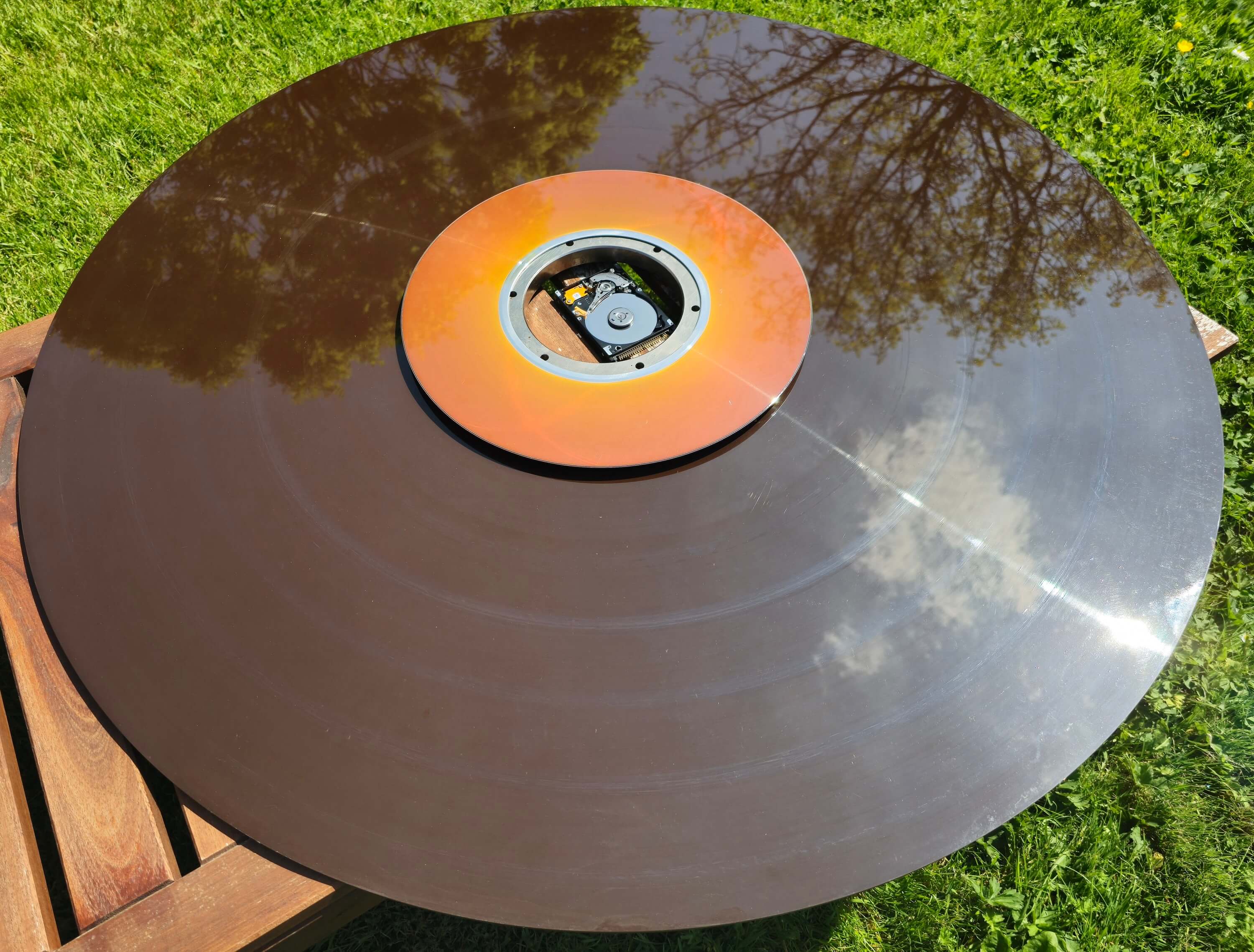 +
Bryant 39" and a 14" + 3.5"
+
Bryant 39" and a 14" + 3.5"
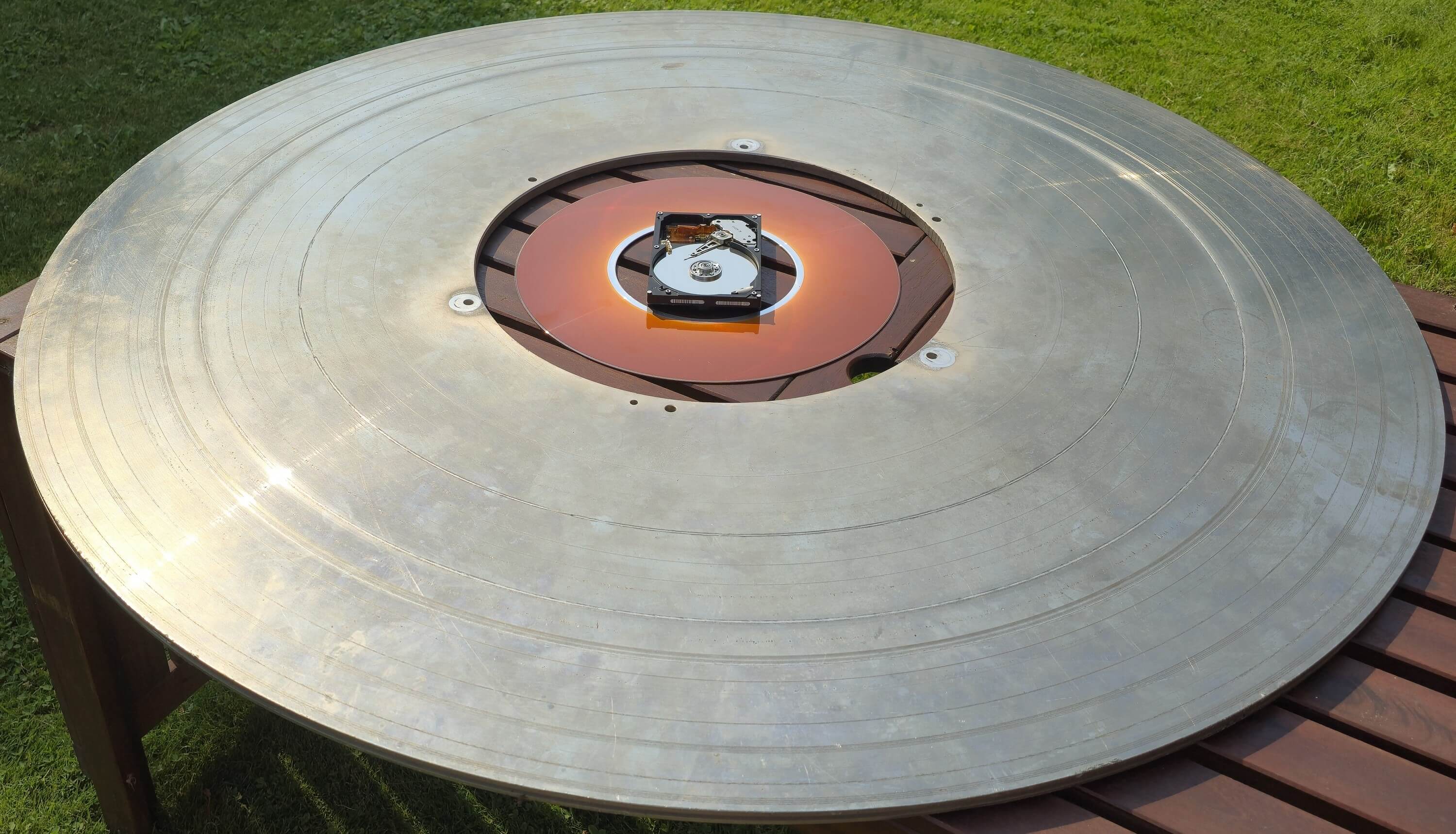 +
Librascope 48" hard disk from 1965 (largest in the world)
+
Librascope 48" hard disk from 1965 (largest in the world)
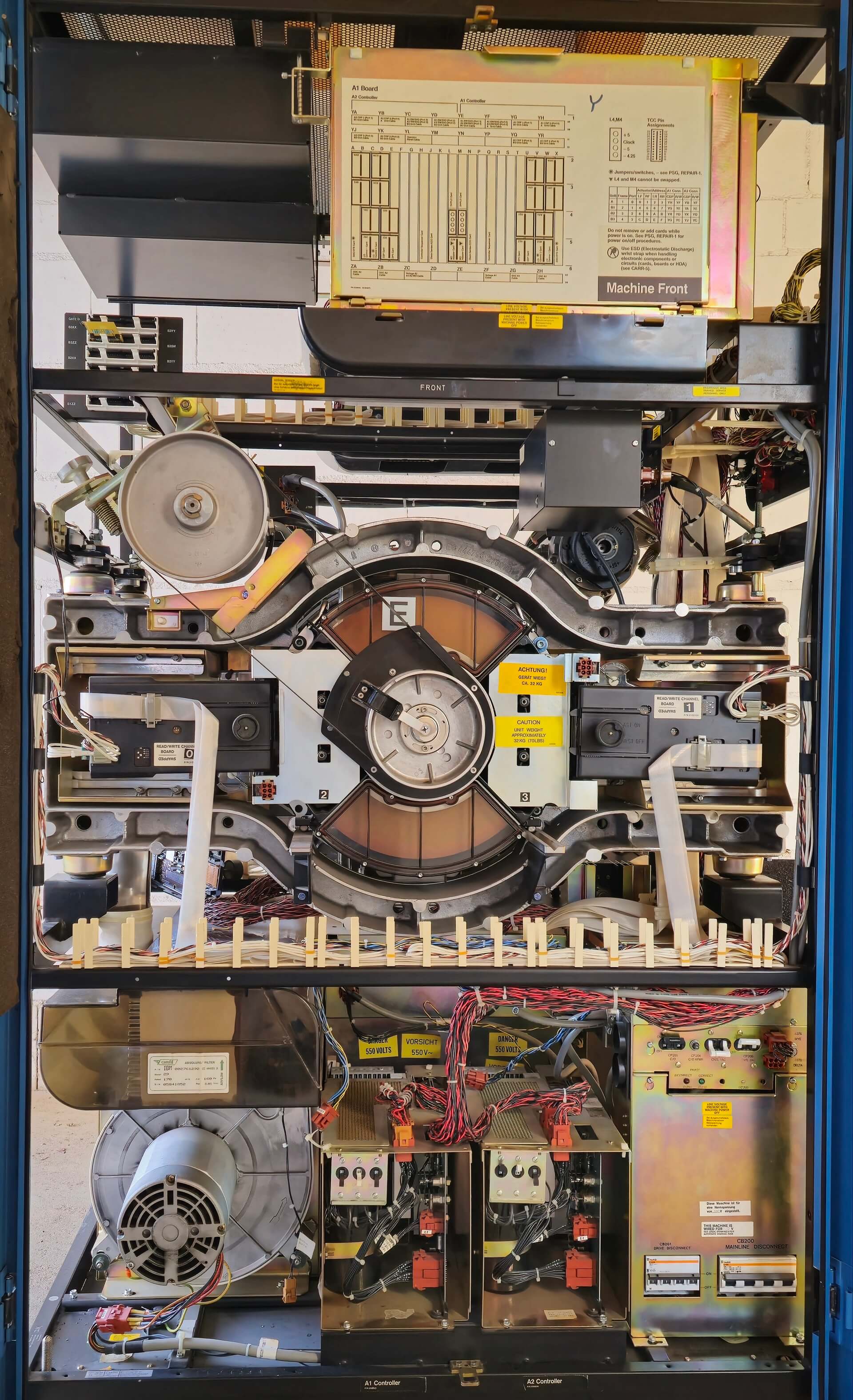 +
Complete IBM 3380 AD/AE
+
Complete IBM 3380 AD/AE
My collection includes countless hard disks, from 0.8 inch up to 48 inches (yes, 48").
For more than forty years I have been collecting hard drives. In the beginning, I focused on contemporary models, but from the 2010s onwards my interest shifted to the large, historic systems. At first, finding a 14-inch disk felt extraordinary. Then came a 24-inch IBM RAMAC platter. The ultimate prize, however, was always the gigantic 39-inch Bryant hard disk platter, which finally entered my collection in 2021.
In 2025, I travelled to Salt Lake City and Provo and spoke with four pioneers, each with remarkable stories to share. One afternoon we sat for hours in a garden, listening to fascinating tales from the dawn of computing. At some point I mentioned my hard disk collection. We went down to the basement, and there it was, a 48-inch hard disk platter that is now also part of my collection.
The Librascope Disk File 48-inch hard disk is the largest ever made. For me, it is one of the crown jewels of my collection, truly the mother of all hard disks.
The 48-inch platter measures 47.5 x 0.46 inches (120.65 x 1.16 cm) and weighs about 100 lbs (45 kg). Each Librascope L-1500 drive contained six platters, giving roughly 18.3 MB per platter and a total capacity of 110 MB.
Only four or five are known to survive worldwide. The other known 48-inch disk platters are owned by Stanford University, the Computer History Museum and the scientist Lester Earnest, who uses one as a coffee table.
I also own several CDC 31-inch hard disk platters. One of the greatest recent additions was a complete, massive IBM 3380 AD/AE with two IBM 3380 E drives inside.
Gigantic 48" Librascope hard disk platter
A note in the Guinness World Records article states that Stanford scrapped the drive in 1975. The controller section was donated to Utah State University, which had taken over the Livermore drive, while the six enormous platters were auctioned to staff members as mementos. Four of these platters are known to survive today. One is on display at Stanford, another is held by the Computer History Museum, and a third was turned into a coffee table by computer scientist Lester Earnest.
But there is actually a fifth that is now know to survive, and it belongs now to Achim Baqué.
Notes from Duane Call (August, 2025, Utah):
Utah State University in Logan, UT, and the University of Utah in Salt Lake City, UT, have no direct affiliation with BYU.
The University of Utah came into prominence within the USA in the late 1960s and early 1970s during the origins of computer graphics. That is where I did my graduate work, and where I first met Robert Bennion, who did not go on to get his degree.
But BYU somehow, back then, in about 1966 or 1967, acquired two Librascopes, one of which I believe housed the platter I gave to you. I was an undergraduate student at BYU at the time and actually helped write a FORTRAN compiler for the Librascope then acquired.
The Electrical Engineering Department received one of the two Librascopes, and the Physics Department got the other one. The engineers got theirs up and running, and it provided useful computing while I myself, incidentally, was off at the University of Utah. The physicists connected the three-phase power backwards on their machine, and it ended up destroying the disc drive, probably the one that I gave to you.
When I got back to BYU to teach, in 1971, after receiving my PhD at the U, the Engineering Department’s Librascope was just being dismantled. When I first returned in the fall of 1971, I, in the new Computer Science Department, and a colleague, Richard Ohran, formed a joint digital logic design lab. We ended up using many, many of the circuit-board edge connectors from Engineering’s now-defunct Librascope to hold circuit boards for our student lab. They happened to be very nice, and otherwise expensive, and they also happened to be completely compatible with the edge connectors in a digital logic design lab that one of my professors, Chuck Seitz, had set up a year or so earlier at the University of Utah. His lab was the model after which we built our lab at BYU.
Yes, that is the same Richard Ohran.
Our logic lab at BYU was very successful. The most otherwise costly circuit-board connectors came from Electrical Engineering, out of the old Librascope, and the curriculum content was adapted from Chuck’s University of Utah lab, with his permission and encouragement.
As it turned out, Chuck Seitz left the University of Utah faculty at the same time I received my PhD, and we worked together at what was probably the first multimedia lab in La Jolla, CA, sponsored by the Burroughs Corporation. Chuck worked with digital video, and I worked with digital audio.
At Utah, Chuck had designed hardware for and with Ivan Sutherland, considered the father of computer graphics, and I, as a student under Thomas G. Stockham, considered the father of digital recording, à la the CD, had done work for Tom.
The Burroughs lab, by the way, called the Burroughs Interactive Research Center, or IRC, was directed by Robert S. “Bob” Barton, known for his design of the first successful stack machine, for which he received the first Eckert-Mauchly Award. The lab was set up by Burroughs just for him as their consultant. Bob was my own major professor at Utah and also left there in 1971 to direct operations at the new Burroughs IRC. All this was while the much, much more famous Xerox PARC activities were going on, which included work by my graduate-student office-mate of the previous four years, Alan Kay.
At the time, from 1971 onward, I held a full-time faculty position at BYU, with one foot outside the university at the IRC sponsored by Burroughs. As I was leaving the University of Utah, Ivan Sutherland told me I could not just go down to BYU and “teach your guts out” at an undergraduate institute. “That’s not what we provided this great education for you to do!” But I did, anyway.
So Barton said I ought to come at least part-time down to La Jolla and be part of his new lab, “so I could keep one foot out of the grubby field of academia, and in the ‘ivory tower of industry.’”
Right off, there in La Jolla at the IRC, both Bob and Chuck told me I should create a logic lab at my new post at BYU, and encouraged and badgered me to do that. So then I re-met Richard Ohran, whom I had met earlier when we were both students there and we both worked on the FORTRAN compiler, and much of the rest is part of his and my history.
Confidential contact
If you own or know of a historically important computer, documentation, software, manuals, parts, photographs, provenance information or related artefacts, please contact me. Messages, photographs and provenance details are treated confidentially.