Lilith (1980)
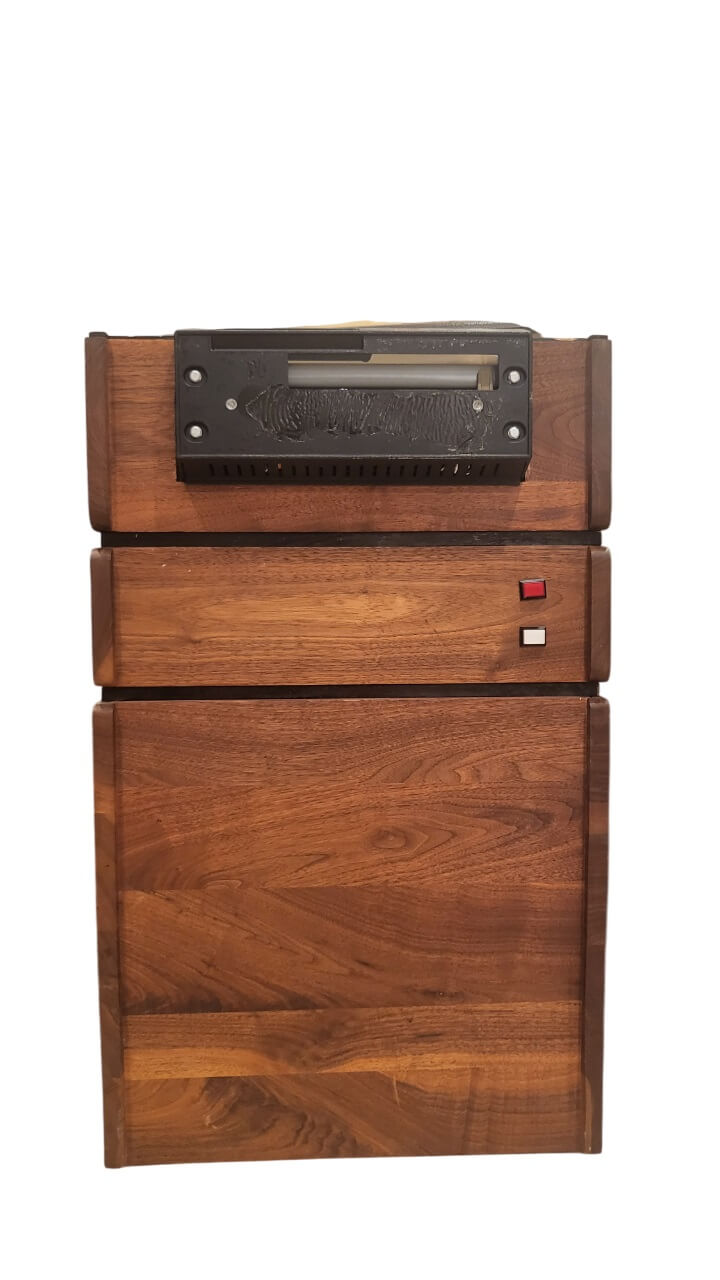
The Lilith workstation in Achim Baqué’s vintage computer collection.
Back to the Vintage Computer Collection
 +
Lilith computer
+
Lilith computer
My Lilith is from the first generation with a Honeywell-Bull 10 MB cartridge disk drive and remains complete, though unfortunately the special upright monitor (model Ball WD17) is missing. The system is housed in a beautifully crafted, heavy walnut case. Only about 20 Lilith still exist and just a few of the first generation with the solid walnut case.
Fortunately, while in Provo, Utah, I had the chance to meet someone who knows the full story behind this remarkable machine. He told me about the type of finish oil originally used on the case. That same oil is still produced today, though now with mineral oil added. I was fortunate enough to track down an original bottle from the late 70s.
In his own words:
The first shipment of 10 or 12 Lilith computers was sent to the ETH without cases or housings. I built plywood boxes enclosing each chassis. The Honeywell-Bull drives were sourced from France and added in Switzerland. Only one chassis received minor frame damage. Since the frame was built with Swiss extrusions, I am told it was easy to replace.
The solid walnut case was built by a student who Richard Ohran found in the student wood shop in the Wilkinson Center at Brigham Young University. Those cases were solid. Even the internal framing was walnut. We would wipe the finish with “Old English” lemon oil.
In the picture, the label on the front of the Honeywell-Bull D120 cartridge drive has come off. I guess the glue was not supposed to last 44 years. The Honeywell-Bull interface was my baby. Farrell Ostler and Richard helped me with it. But I got it designed and built. It employed a serial interface. As I recall, the bitstream had a preamble, the sector address and the sector data followed by a cyclic redundancy code at the end of the stream.
On the top of the drive was a label in French and English: Warning, Mighty Magnet. In French it literally translated as big lover. Because the magnet was on top, they were trying to protect us from setting a magnetic cartridge on top. Those cartridges were also sensitive to bring dropped even a few centimetres. If the cartridge was dropped, the alignment would be off and the cartridge would need to be reformatted and the data rewritten.
We built our chassis using a Swiss frame for a DEC computer. Maybe a PDP-8. I don’t recall the model. The connectors had wire-wrap pins. To connect the pins, we used a wire-wrap gun with a “cut, strip, modified wrap bit.” We loaded the wire in the bit and pushed the trigger. That bit made the process go a lot faster than measuring, cutting, stripping and wrapping each wire. The only downside was the bits were expensive and, like the drive cartridges, sensitive to being dropped.
We hand-taped the double-sided printed circuit boards in the fall of 1978. Initially, we learned how to lay out the PC boards in an office where a number of men designed boards for Becton-Dickinson Immunodiagnostics, a division of the hospital supply company now known as BD. They built a washing machine-sized blood analysis/assay machine. Richard Ohran was friends with the manager and he let us lay out the boards on light tables next to the rest of the team.
To design the printed circuit board, several vinyl sheets were pinned at the top to create a common datum. We placed preformed labels on one of the sheets representing the pads for each of the integrated circuits, resistors, capacitors and other through-hole components.
Then we placed black sticky-backed crepe tape on two more vinyl sheets that represented the front and back sides of the board. A large format camera was used to copy the 2x back-lit layout so the master for the PC boards could be built. Then the pc board manufacturer drilled out the holes and plated them through, connecting the pads and traces on both sides.
Because we made a short run, we didn’t redesign the printed circuit board when we needed to make a small change. Thus, you will see soldered wires on the board.
This was a common practice that can be seen on DEC, UNIVAC and Data General boards of the period.
About the Lilith
The Lilith was a groundbreaking personal workstation developed in the late 1970s at ETH Zurich by Niklaus Wirth, the inventor of Pascal, together with his research team. Designed primarily as a development platform for Wirth’s Modula-2 programming language, Lilith combined innovative hardware with forward-looking software concepts.
Btw, the custom cabinets were made by S.B. Yancey were indeed manufactured in Utah.
At a time when most personal computers still relied on text-only displays, Lilith featured a bitmapped, high-resolution graphical user interface and a mouse, offering interaction in a way that foreshadowed modern computing. It was heavily inspired by the Xerox Alto, the same machine that later influenced the Apple Lisa, Macintosh, and Microsoft Windows.
Technically, Lilith was powered by a microcoded processor implemented with AMD 2900 bit-slice components. Its custom architecture allowed for efficient execution of high-level languages, making it uniquely suited for teaching and software research. Around 120 machines were built, mostly used within ETH Zurich and by a few collaborators.
Today, Lilith holds a special place in computer history as one of the earliest examples of a personal workstation with a GUI. While never produced commercially on a large scale, it helped pave the way for the systems and interfaces that became standard in the 1980s and beyond.
Confidential contact
If you own or know of historically important computers, documentation, software, manuals, parts, photographs, provenance information or related artefacts, please contact me. Messages, photographs and provenance details are treated confidentially.