1-Bit Computer (1981)
The 1-Bit Computer in Achim Baqué’s vintage computer collection.
Back to the Vintage Computer Collection
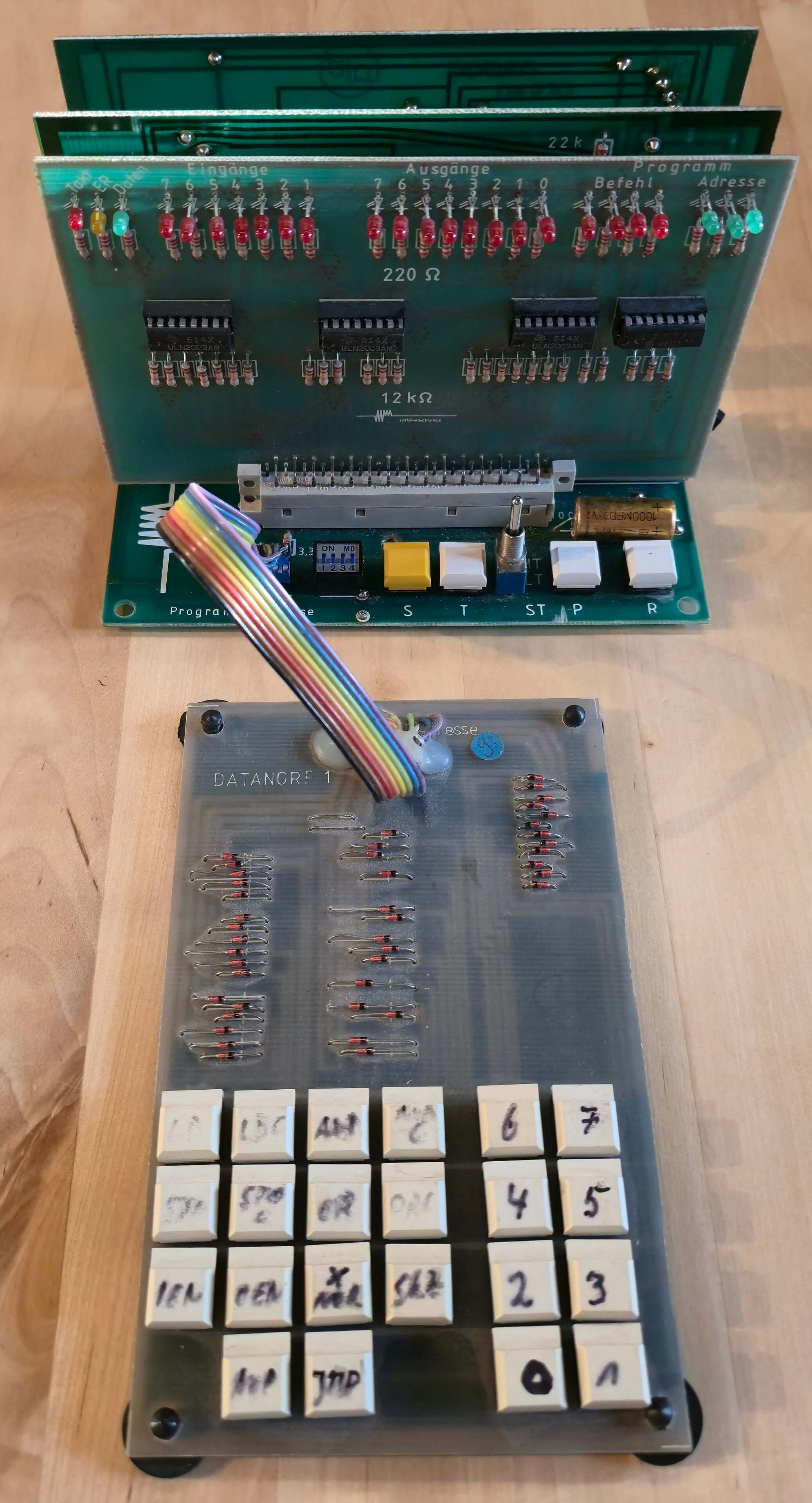 +
WDR-1-Bit-Computer
+
WDR-1-Bit-Computer
This computer was almost impossible to find, a few people remembered it and information was only available on a website from the inventor's son. Otherwise, there are only a few replicas.
In 2025, the time had finally come and I met his son, Kai Ludwig. We got on really well, spent endless hours talking and are planning to realise several projects together in the future. Thanks to Kai, I now own one of these extremely rare 1-bit computers from 1981. It seems that only Kai Ludwig and I own this computer.
A brief summary of the story: At the beginning of the 1980s, the German physics teacher Burkhard John and Volker Ludwig built a 1-bit computer for training purposes and initially offered it in amateur radio groups. It was published in the magazine cqDL 6/84.
The computer was offered for sale. It was a do-it-yourself computer (only PCB boards were offered), but small numbers of finished computers were also offered.
Later in 1985, a German television station (WDR - Westdeutscher Rundfunk), which had a computer show called ‘WDR Computerclub’ in its show, became aware of this. In a six-part series, the construction and use was explained by the inventor's family, with his son soldering the circuit boards live during the show.
Based on the Motorola MC14500B “Industrial Control Unit”, this machine operated on a strict one-bit architecture, processing only binary states, zero and one.
The system’s simplicity made it an ideal learning tool. Using just one bit of data, it could execute a fourteen‑instruction set, enabling functions in logical decision‑making rather than arithmetic. Its memory design included two chips capable of holding 256 instructions, each four bits wide. The architecture made it particularly well-suited to teaching fundamental computing concepts through tangible, hands‑on experience.
The WDR-1-Bit-Computer remains an influential example of how even the simplest computing architectures can impart key lessons in logic, control flow, and digital thinking. Its legacy lies not in advanced performance, but in educational clarity, demonstrating that understanding the essence of computing does not require complex machines, only thoughtful design.
Confidential contact
If you own or know of historically important computers, documentation, software, manuals, parts, photographs, provenance information or related artefacts, please contact me. Messages, photographs and provenance details are treated confidentially.