Ontel OP-1 (late 1970s)
The Ontel OP-1 in Achim Baqué’s vintage computer collection.
Back to the Vintage Computer Collection
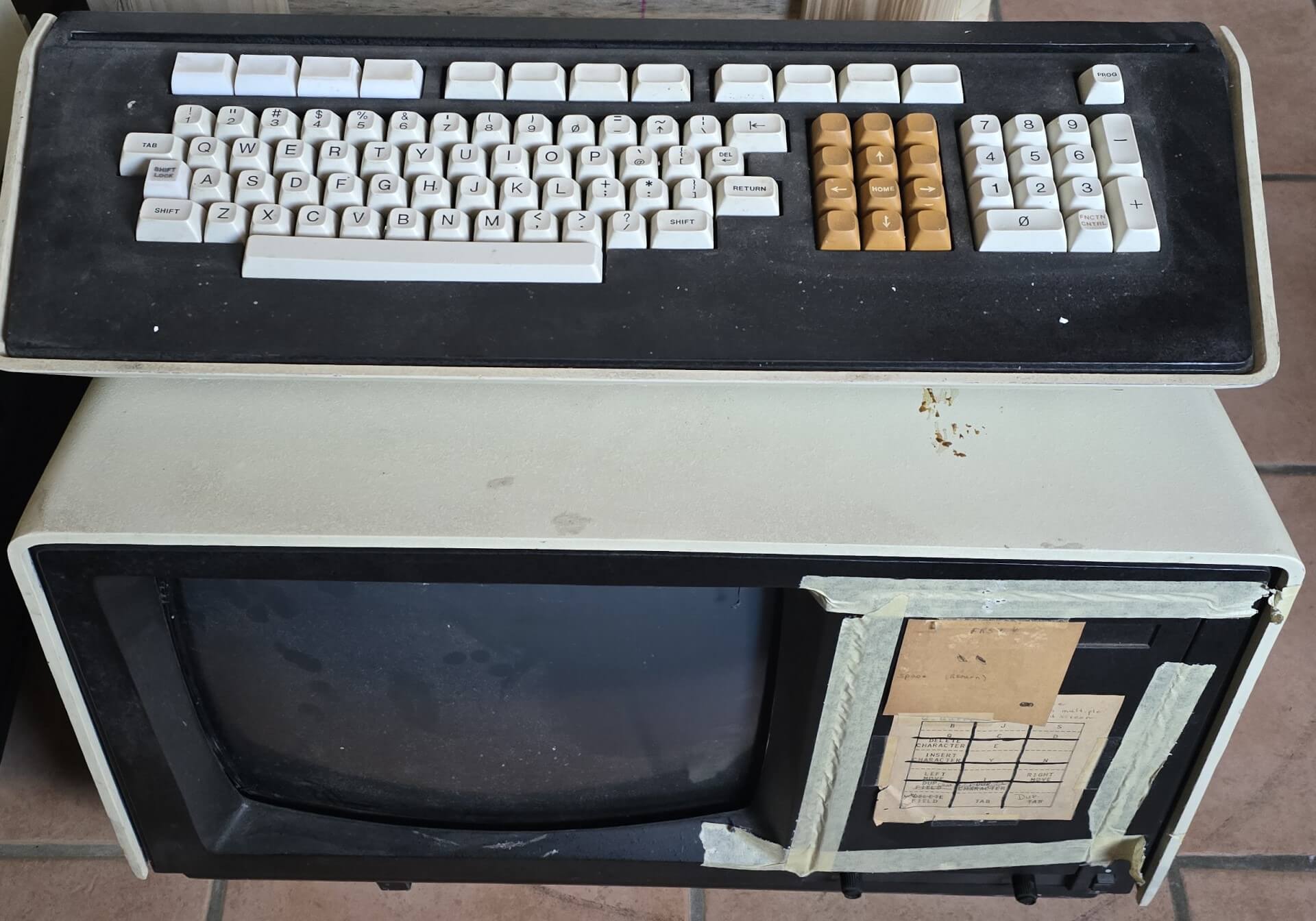 +
Ontel OP-1 (before it was cleaned)
+
Ontel OP-1 (before it was cleaned)
The Ontel OP-1 is extremely rare. I am aware of only the one I own. The owner tried unsuccessfully to get the computer working again. He had taken it completely apart, but without success. Some components would need to be replaced. However, it is more important to me to preserve the computer and not lose its originality in order to get it up and running. The history is much more important to me.
Externally, the computer shows some signs of wear, but the circuit boards are in excellent condition.
A Pioneer of Early Desktop Computing
The Ontel OP-1 is a lesser-known but fascinating example of early desktop computing. Developed by Ontel Corporation in the late 1970s, the OP-1 was part of the wave of microcomputers that emerged during the transition from large minicomputers to smaller, more personal systems. While it did not reach the widespread fame of contemporaries like the Apple II or the Commodore PET, the Ontel OP-1 holds an interesting place in computing history as an early attempt at an “office computer” with advanced features for its time.
The Ontel OP-1 was designed as a multi-user, multi-terminal microcomputer aimed primarily at business and office environments. Unlike single-user personal computers, the OP-1 could support multiple users working at the same time, connected via terminals. It was marketed as a flexible solution for tasks such as word processing, data entry, and basic business computing.
Technically, the OP-1 used an Intel 8080 microprocessor, which was a common choice for microcomputers of that era. It could be equipped with multiple terminals, floppy disk drives, and printers. Its modular design allowed businesses to expand their systems according to their needs. The operating system was proprietary and often included software for common office tasks, which was quite advanced compared to many single-user systems of the time.
One of the OP-1’s notable features was its focus on making computing accessible to office workers who had little or no technical background. Its integrated terminals and relatively user-friendly interface made it easier to perform business tasks that would previously have required more expensive and complex minicomputer setups.
Although the Ontel OP-1 did not become a mainstream success, it illustrates an important phase in the evolution of computing: the shift from centralized mainframes and minicomputers to distributed systems and personal workstations. It competed in a crowded market and faced tough competition from emerging personal computers that quickly became cheaper and more powerful.
Today, the Ontel OP-1 is remembered by vintage computer enthusiasts and collectors as an example of the creativity and experimentation that defined early desktop computing. It shows how many companies, large and small, contributed ideas that shaped the modern computer workplace.
In conclusion, the Ontel OP-1 may not be widely known, but it represents an important step in the history of making computers practical for everyday office work. Its multi-user design and focus on business tasks paved the way for later office computers and networked systems, which are now an essential part of our digital world.
Confidential contact
If you own or know of historically important computers, documentation, software, manuals, parts, photographs, provenance information or related artefacts, please contact me. Messages, photographs and provenance details are treated confidentially.