Early Intel development systems (1972–1982)
Early Intel development systems in Achim Baqué’s vintage computer collection.
Back to the Vintage Computer Collection
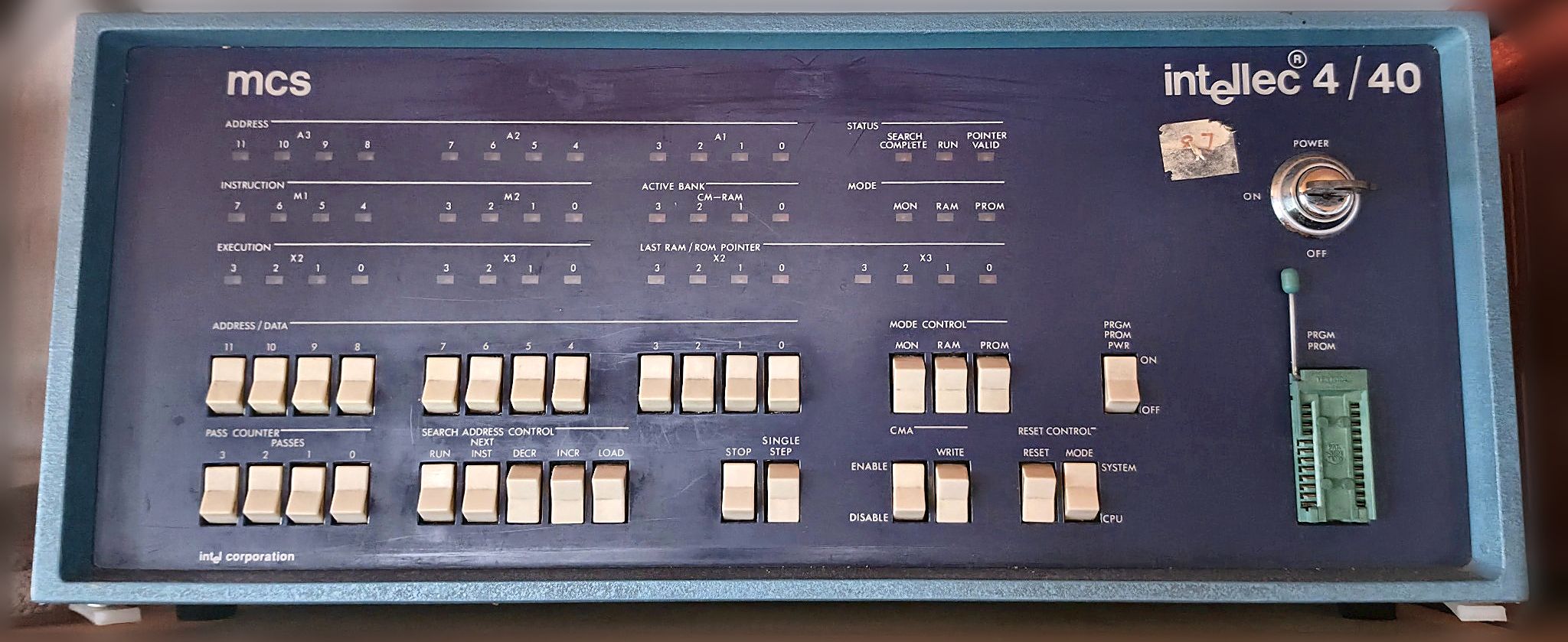
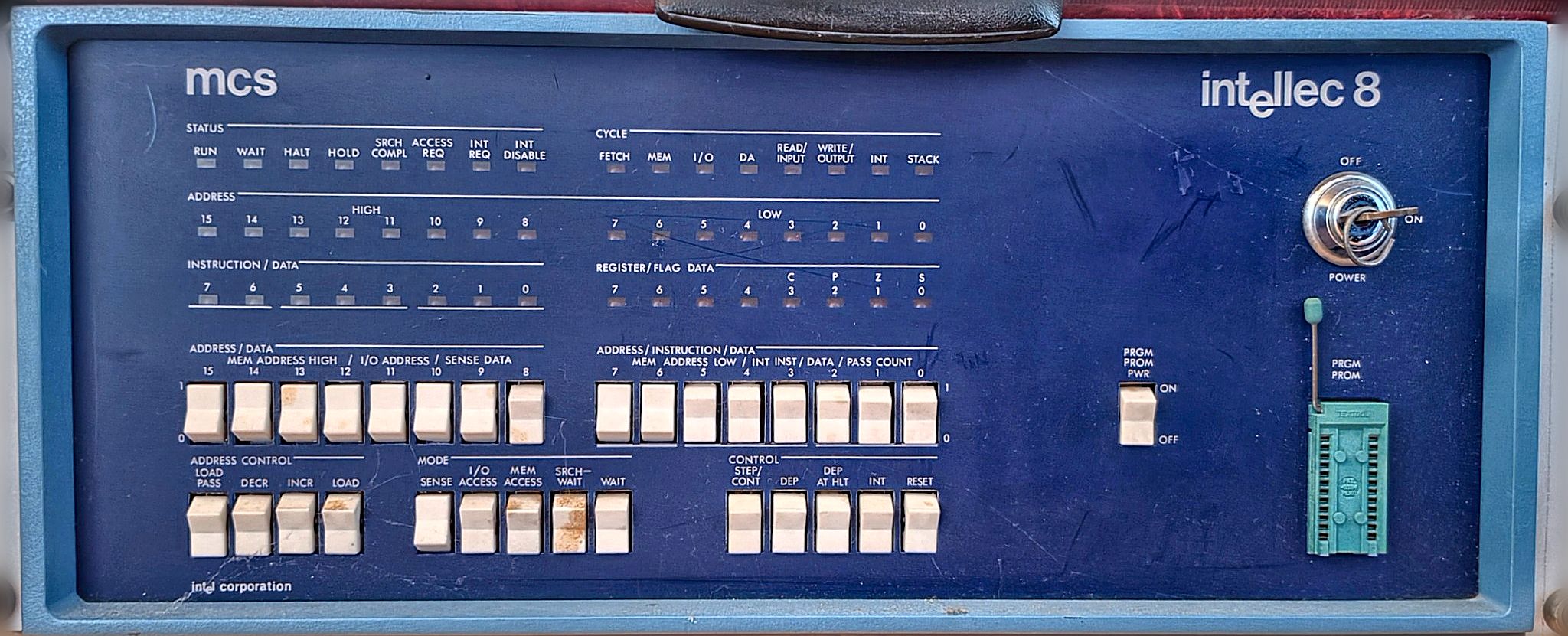
Intel offered boards and complete systems that allowed engineers to develop products with its new microprocessors. My collection includes several of them: the SIM8-01 for the 8008, the Intellec 4 and Intellec 8, the PROMPT 48, the SDK-85 and SDK-86 kits and the iSBC 86/12A and iSBC 86/30 single-board computers.
SIM8-01 (1972)
Intel introduced the 8008, its first 8-bit microprocessor, in April 1972, only five months after the 4004. As early as its 8008 manual of April 1972, Intel described "a complete prototyping system, the SIM8-01", built on a single board. It carries the 8008 CPU with a 500 kHz system clock, 1K × 8 of RAM, sockets for 2K × 8 of PROM in eight 1702 chips, six I/O ports and a Teletype interface. The SIM8-01 has no front panel: programs ran from PROM or were loaded from a Teletype using bootstrap loader PROMs. Together with the separate MP7-03 board, the SIM8-01 also served as the controller for programming Intel PROMs. According to Intel, the simulator boards were the forerunners of the Intellec computers.
Intellec 4 and Intellec 8 (1973)
Intel offered the Intellec 4 and the Intellec 8 together at the National Computer Conference in June 1973. The Intellec 4 is built around the 4004, the Intellec 8 around the 8008. Both are complete development computers in a cabinet with a control and display panel offering address and data entry switches and displays for status, instruction code, data and address. They came with a monitor in PROM and a resident assembler, could be connected to a Teletype and offered an optional PROM programmer with a socket for 1702A PROMs on the front panel.
For the 8080, Intel did not change the original machine but introduced the separate Intellec 8/Mod 80 and offered a conversion kit for existing Intellec 8 systems. A famous user of these machines was Gary Kildall: he developed the programming language PL/M for Intel and, in 1974, created his operating system CP/M on an Intellec 8.
PROMPT 48 (c. 1976/1977)
The MCS-48 single-chip microcomputer family was announced in November 1976, and the PROMPT 48 was Intel's "complete design aid and EPROM programmer" for it. It came with an 8748 and an 8035, had 1K of writable program memory and 256 bytes of data RAM, a built-in keyboard and eight 7-segment LED digits, single-step operation and up to eight breakpoints, a serial port for a terminal and an EPROM programming socket. Programs were entered in hexadecimal.
MCS-85 and SDK-85 (1977)
Intel announced the 8085 and its MCS-85 support chips in November 1976 at the Electronica fair in Munich, with production expected by April 1977. The 8085 needs only a single +5 V supply and integrates the clock generator and system controller, which the 8080 required as separate chips; it remained software-compatible with the 8080. The SDK-85 System Design Kit of 1977 is a single-board kit with a 3 MHz 8085, 2K of ROM with the monitor, 256 bytes of RAM, a 6-digit LED display, a 24-key keyboard, a Teletype interface and a wire-wrap area for the user's own circuits. According to Intel, assembly took three to five hours.
SDK-86 (1978/1979)
The SDK-86 is the corresponding single-board kit for the 16-bit 8086, documented from late 1978. It runs at 2.5 or 5 MHz and offers 8K of ROM with monitors, 2K of RAM (expandable to 4K), 48 parallel I/O lines, a serial port, an 8-digit LED display and a 24-key keyboard. Programs could also be downloaded from an Intellec development system.
iSBC 86/12A (1979) and iSBC 86/30 (c. 1981/1982)
The iSBC 86/12A is an 8086 single-board computer for Intel's Multibus, documented in 1979. It has 32K of dual-port dynamic RAM, sockets for up to 16K of ROM/EPROM, a serial interface, 24 programmable parallel lines, three 16-bit timers and an interrupt controller. Its successor, the iSBC 86/30, uses an 8086-2 at 5 or 8 MHz with 128K of dual-port RAM and was designed as a direct replacement for the iSBC 86/12A.
Sources: Intel 8008 manuals (April and November 1972), Intellec 8/Intellec 4 brochure, Intellec 8/Mod 80 Reference Manual (1975), Intel Data Catalogs 1975–1979, PROMPT 48, SDK-85, SDK-86 and iSBC manuals (all bitsavers.org) · Electronics, 24 May 1973 and 9 December 1976 · Intel: The 8008 · Computer History Museum: CP/M source code